
Just One Bathroom: How a Single-Room Renovation Gets Quoted, Permitted and Scheduled
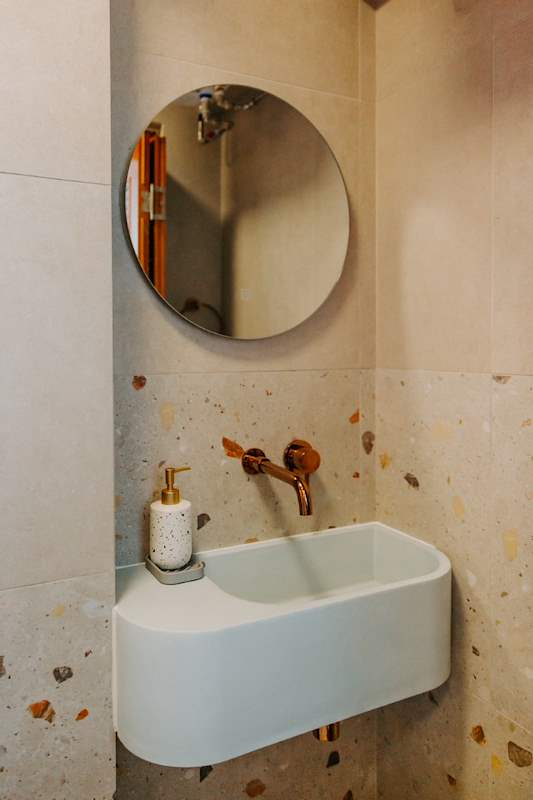
Pictured above: a finished bathroom from our project archive (140BB) — wall-hung basin, wall-mounted mixer and full-height tiling. One room, done properly, is a complete job in its own right.
Most renovation content in Singapore assumes you are doing the whole flat. Keys collected, everything hacked, one package price. But a large share of the enquiries we get are nothing like that: the family bathroom is twenty years old, the floor tiles are hollow, the toilet rocks slightly, and the rest of the home is perfectly fine. One room. Nothing else.
That job is harder to get quoted than a full renovation, and the reasons are worth understanding before you start calling people. Some contractors will not take it. Some will quote a number that looks wildly high next to a per-bathroom figure from a whole-flat package. Neither is unreasonable, once you know how a single-room job is actually costed.
Why one bathroom costs more per square foot than four
Almost every cost in a bathroom is a fixed cost that does not care how many bathrooms there are.
- Every trade still has to come. A hacker, a waterproofing applicator, a tiler, a plumber, an electrician. Each arrives, works, and leaves, whether there is one room or three. In a full renovation those visits are spread across a lot of work; in a single-bathroom job they are spread across one room.
- Hacking and disposal are the same either way. A skip or a disposal run, the trolleying of debris out of a flat, the lift protection, the corridor protection. The disposal rules do not get cheaper because there is less of it.
- Waterproofing is a full system regardless of size. A two-coat membrane over the whole floor and 1.5m up the wet walls, then a mandatory 24-hour ponding test before any tiling. That is the same specification in a 4 sqm toilet as in a big master bath.
- Mobilisation and permits. Setting up, protecting the route through your home, applying for the renovation permit in an HDB flat, and being there to supervise.
Our published guide for bathrooms is $5,000 to $12,000 for an HDB bathroom, common or master, with a full hack-and-retile including new toilet, basin, mixer, shower, vanity and waterproofing typically landing between $7,000 and $10,000. Condo bathrooms run $8,000 to $20,000 and landed $10,000 to $25,000 and up, because the rooms are bigger and the specification usually is too. Those ranges are on our bathroom renovation page, and they are the same whether you are doing one bathroom or all of them — which is exactly the point. The per-room number in a whole-flat package is not lower because the bathroom is cheaper; it is lower because the setup is shared.
The permit still applies to one room
Doing one bathroom in an HDB flat is renovation work like any other. Hacking tiles and redoing the floor finishes and waterproofing in a wet area is permit work, and the permit is applied for by the renovation contractor — who must be on HDB's register — not by you. Ours is HB-09-5667H.
Two things follow from that. First, a "handyman" who is not registered cannot apply for a permit, which tells you what kind of job he is planning to do. Second, the hacking-hours rules and the limit on consecutive days of hacking apply to your small job in exactly the same way they apply to a big one, so your neighbours will be affected and it pays to tell them. The detail is in our HDB renovation permit guide and the noise rules.
The waterproofing is the job. Everything else is finishing
If you take one thing from this article, take this: in a bathroom, the tiles are decoration and the membrane underneath is the building work. A bathroom that leaks into the unit below is one of the most expensive small problems in Singapore property, because by the time it shows up on somebody else's ceiling, the fix means hacking your new tiles off again.
So the sequence is not negotiable:
- Hack out old tiles and screed, down to the structural slab.
- Check and repair the slab surface, and deal with the floor trap and pipe penetrations, which is where most old bathrooms actually fail.
- Apply the waterproofing membrane — two coats, full floor, 1.5m up the wet walls, turned into the doorway threshold.
- Ponding test: flood the floor and leave it 24 hours. Someone should look at the ceiling below during that time, not just at your own floor.
- Screed to the correct falls, so water runs to the trap and not to the door.
- Tile, grout, fit sanitaryware, silicone the junctions.
The ponding test is a full day where nothing appears to happen. A contractor who offers to "save you a day" there is offering to skip the one step that proves the work. There is more on the membrane itself in our waterproofing article.
The things that turn a simple bathroom into a complicated one
When we survey a single-bathroom job, these are what change the price:
- Moving the toilet or the floor trap. Fixtures connect to a soil pipe in a fixed position. Moving the WC even half a metre can mean building up the floor to keep the fall, which raises the finished level, which changes the door, which changes the threshold detail. Keeping fixtures where they are is the single biggest saving available to you.
- Overlay versus hack. Tiling over existing tiles is faster and cheaper, and it buries whatever waterproofing you already have — including its faults — and raises the floor. It has its place, mostly where the existing bathroom is sound and fairly new. It is not the answer for a twenty-year-old bathroom with hollow tiles.
- An existing leak. If the neighbour below already has a stain, you are not doing a renovation, you are doing a repair with a renovation on top, and the sequence and the conversation with them both change. See who is responsible for a ceiling leak.
- Concealed pipework and a new water heater. Chasing walls for concealed pipes, or a different heater position, brings the electrician in and can mean a new circuit.
- Whether you are supplying the sanitaryware. Perfectly fine — but it changes who owns the problem when something arrives late, arrives damaged, or does not fit the hole. We have written about buying your own materials.
Living without the bathroom
In a flat with two bathrooms, this is an inconvenience. In a flat with one, it is a plan. The room is unusable from the day hacking starts until the sanitaryware is fitted and the silicone has cured, and the 24-hour ponding test sits in the middle of that.
Ask for the sequence with dates before work starts, decide where the household will shower, and — if you have elderly parents or young children at home — say so at the survey, because it changes how the work is staged. Doing the two bathrooms of a flat one after the other, rather than together, costs more and keeps one always working. That is a legitimate choice and worth asking about.
What to send so the price comes back firm
You will get a far better number, faster, if you send this instead of "how much to renovate a bathroom":
- Property type and which bathroom it is (common, master, powder room).
- Four photos: the whole room from the door, the floor, the shower area, and the ceiling below if there is any stain.
- Whether you want hack-and-retile or an overlay.
- Whether the toilet, basin and shower stay where they are.
- Whether you are supplying any sanitaryware yourself.
- Any known leak or complaint from the unit below.
Then ask three questions of anyone quoting: who does the waterproofing and is it their own crew; will they show you the ponding test; and what warranty is given on the waterproofing specifically, in writing. A contractor who answers those three clearly is the one to hire, whatever the price ends up being.
The short version
- One bathroom is a proper job, not a favour. The fixed costs are the same as in a full renovation, which is why it looks expensive per square foot.
- Published ranges: $5,000-$12,000 for an HDB bathroom, typically $7,000-$10,000 for a full hack-and-retile; $8,000-$20,000 condo; $10,000-$25,000+ landed.
- The permit rules apply to one room exactly as they do to a whole flat, and only an HDB-registered contractor can apply.
- The membrane and the 24-hour ponding test are the job. Nobody should be offering to save you that day.
- Keeping the toilet and floor trap where they are is the biggest saving available.
- Overlay is faster and buries whatever is underneath, faults included.
- If the flat has one bathroom, ask for the sequence with dates before work starts.
Want one bathroom quoted properly? WhatsApp us on 9107 2601 with the photos above and we will tell you what it needs — including when the honest answer is a repair rather than a renovation. Full scope and pricing is on our bathroom renovation page.
Related reading: bathroom waterproofing, and what it costs · what is worth keeping in an older flat · how to compare renovation quotations