
HDB Wall Hacking in Singapore: Which Walls You Can Remove
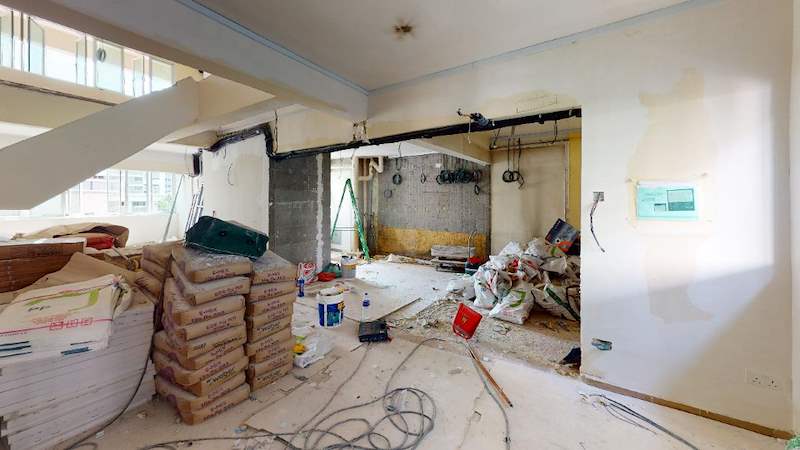
Almost every renovation conversation reaches the same moment. Someone stands in the living room, points at a wall, and asks whether it can come down. The honest answer is that it depends on what the wall is made of and what it is holding up — and that neither you nor your contractor gets to decide it. HDB does, and the flat's approved plan is what settles it.
This is how hacking actually works in an HDB flat: which walls are usually removable, which are never touched, what needs a permit, and the checks worth doing before you commit to a layout that may not be allowed.
Two kinds of wall, and only one of them is negotiable
Inside a flat you are dealing with two broad categories.
Structural walls are reinforced concrete. They carry load and they are part of how the block stands up. They cannot be hacked, and no permit exists that will let you remove one. This is not a case of an expensive workaround or a stronger beam — the answer is no, and a contractor who tells you otherwise is telling you something that will fail at permit stage or, far worse, will not be caught until it has been done.
Non-structural walls — brick, block or lightweight partition — divide space without carrying the building. These are the ones that can usually be removed or partially removed, with an approved permit and by a contractor who is allowed to do it.
The catch is that you cannot reliably tell which is which by knocking on it. Plaster and skim coat make a brick wall and a reinforced concrete wall feel similar under your knuckles, and a wall being thin is not proof it is non-structural. The answer lives on the flat's approved plan, not in the room.
Newer flats have far less hacking freedom than older ones
This surprises people who have watched a friend open up an older flat and assumed the same is possible in theirs. Construction methods changed. Older blocks used more brick and block partitions internally, which is why some older flats can be opened up substantially. Many newer flats use reinforced concrete far more extensively inside the unit, and in those the internal walls that look like partitions are structural.
The practical consequence: if you are buying a resale flat specifically because you intend to knock through and create an open-plan living and dining area, check what the walls are before you commit to the flat, not after. It is a question that can be answered early and cheaply, and it changes what a flat is worth to you.
The household shelter is not on the table at all
Every flat built with one has a household shelter, and it is the single clearest rule in the whole exercise. You cannot hack it, you cannot remove it, you cannot take the door off, and you cannot drill into its walls, ceiling or floor to hang anything. That includes the tempting idea of turning it into a walk-in wardrobe with proper fitted shelving screwed to the wall.
People do work around it — freestanding storage inside it, a curtain or a light frame outside it that does not fix into the shelter itself — but the shelter's structure stays exactly as it was handed to you. Treat this one as fixed and design around it from the start rather than hoping.
Wet areas need more than permission to hack
Bathrooms and kitchens carry a second problem on top of the structural one: waterproofing. Under the tiles there is a membrane, and hacking floor or wall finishes in a wet area risks breaching it. A breach that is not properly made good does not show up during the renovation. It shows up months later as a damp patch on your neighbour's ceiling, and by then it is your problem to fix and their goodwill you are spending.
HDB places restrictions on work that would disturb the original waterproofing in newer flats, and the rules differ depending on how old the flat is. Do not plan a bathroom layout change on the assumption it will be allowed — confirm the current position for your flat's age with HDB or through your contractor before the design is fixed. If hacking is permitted and you go ahead, re-waterproofing and a proper water test afterwards is not an optional extra.
Our guide to bathroom waterproofing and what it costs covers what a proper job involves.
Hacking needs a permit, and the permit needs a registered contractor
Hacking works in an HDB flat require a renovation permit, and the permit is applied for by an HDB Registered Renovation Contractor — not by you. That registration is the mechanism HDB uses to keep structural work in the hands of people who are answerable for it.
Larry Contractors Pte Ltd is an HDB Licensed Renovation Contractor, licence HB-09-5667H. If you are comparing quotations, ask every contractor for their HDB registration and check it. A quotation that includes hacking from someone who cannot apply for the permit is a quotation for a problem.
Permitted hacking also has to be carried out within HDB's allowed working hours, and debris has to be removed properly rather than left in the common corridor. The full picture on permits, approvals and what gets checked is in our HDB renovation permit guide.
What to do before you fall in love with a layout
The order that saves the most money and disappointment:
- Get the flat's approved plan. This is the document that shows what the walls are. Everything else is guesswork until you have it.
- Mark what you want to remove on that plan before drawing the new layout. It is much easier to design around a wall you know is staying than to redesign after a permit is refused.
- Ask your contractor to confirm against the plan, in writing. "We'll see when we start" is not an answer at quotation stage — it is a way of deferring a refusal until after you have paid a deposit.
- Ask what happens to the services in that wall. Wiring, switches, and sometimes pipes run inside walls. Removing the wall means re-routing them, and that cost belongs in the quotation now, not as a variation later.
- Ask about making good. When a wall comes out, the floor, ceiling and adjoining walls all carry a scar where it used to be. Someone has to patch, level and finish that, and it should be named in the scope.
The alternatives when the answer is no
A refusal is not the end of an open layout. Most of what people actually want from knocking a wall down — light, sightlines, a room that does not feel closed in — can be had without touching structure:
- Partial openings in a non-structural wall: a wide doorway or a pass-through instead of removing the whole wall.
- Glass partitions where a solid wall is not needed for privacy, which keep light moving through the flat.
- Half walls and open shelving that divide function without dividing the space visually.
- Doors that stop eating space — sliding or pocket doors recover the floor a swing door needs.
We covered these in more detail in partition walls: drywall, glass and half walls, which is worth reading alongside this if a wall you wanted gone turns out to be structural.
The short version
Reinforced concrete walls stay. The household shelter stays, entirely and without exception. Non-structural walls can usually go with an approved permit, applied for by a registered contractor. Wet areas carry a waterproofing question on top of the structural one, and newer flats generally allow far less hacking than older ones. Settle all of this against the approved plan before the layout is designed, not after.
Related reading: renovating while living in the flat and how to read and compare renovation quotations.
Not sure what your walls are?
Send us the flat type and what you are hoping to open up, and we will tell you what is realistic before you spend anything on a design. Message us on WhatsApp, or see HDB renovation for what we do and how we work.
Related: if works have already damaged a neighbour's unit, see renovation damage to your neighbour's unit — who pays.
The same structural logic decides what may be chased into a wall for cabling. We cover that in electrical work in a Singapore renovation.
If the wall you are asking about was removed by someone else before you owned the flat, the question changes shape — see buying a resale flat with unapproved renovation works for what to establish before you exercise the option.
Related: one room in the flat has stricter rules than any wall — see what you are not allowed to do to an HDB household shelter.
Related: Renovation debris and waste disposal — the rules and what goes wrong.
Also worth reading: drywall and partition walls: what to know before you build one
Also worth reading: Renovate before selling your HDB flat, or sell as-is? — selling an HDB flat: what HDB checks for and what to fix first.