
Renovate Before Selling Your HDB Flat, or Sell As-Is? What to Fix and What to Leave
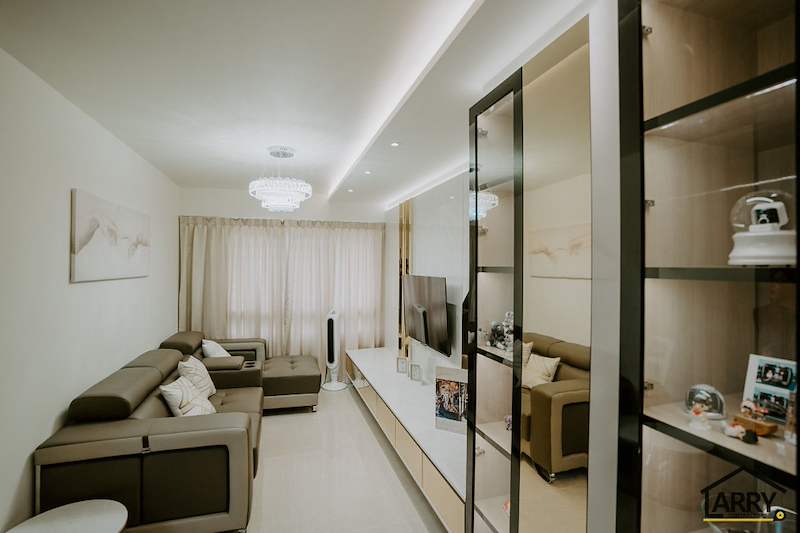
Pictured above: a living room from a completed HDB flat renovation in our project archive (C10) — cream laminate, a floating TV console and a glass display cabinet.
If you are about to sell an HDB flat, the renovation question usually shows up in the same week as the agent's first visit: should you redo the kitchen, repaint everything, replace the tiles — or list it as it is? The answer is not the same for every flat. But one part of it is not optional, and it is the part most sellers find out about last: what HDB itself checks when you sell, and what you have to put right before completion.
This guide sorts pre-sale work into three groups — what you must deal with, what is worth fixing, and what to leave alone — and gives you the questions to ask before you commit any money.
Group 1: What you have to deal with, whatever it costs
According to HDB's resale process, once HDB accepts your resale application, officers from the HDB Branch arrange to inspect your flat. The purpose of that inspection is to check for unauthorised renovation works that may damage HDB property or affect the structural stability of the flat or the building. If any are found, HDB's terms say you have to rectify them before the resale is completed, and you may need to arrange another inspection with the Branch afterwards.
Two details in that wording are easy to miss:
- It is the seller's job to fix it. HDB's resale terms expect the seller to regularise or remove unauthorised works before completion. It is not something to leave for the buyer to sort out after the keys change hands.
- The inspection is not a quality check. HDB describes it as a check for unauthorised works — not a valuation, and not an opinion on the condition or safety of the renovation work in the flat. A flat can pass it and still have a badly finished bathroom or a leaking pipe.
HDB's resale terms also say that no renovation works should be carried out to the flat while the resale is pending completion. So the time to sort out anything doubtful is before the application is accepted, not in the gap between acceptance and completion. Read the current terms on hdb.gov.sg, or ask HDB directly, before you plan the timing of any work — the wording is theirs, not ours, and it can be updated.
How to tell whether you have anything to rectify
Walk the flat with the original floor plan for your flat type in your hand. Almost every unauthorised-works problem shows up as a difference between the plan and the room:
- A wall that is on the plan but not in the flat — or a wall in the flat that is not on the plan. Our guide to which HDB walls you can remove explains how to tell the difference.
- Raised platforms, stepped floors or tiles laid over tiles, especially in wet areas.
- Enclosed service yards, ledges or balcony areas that no longer match the original layout.
- Extra rooms created by partitions, or rooms whose doors and windows do not match the rest of the flat.
If you bought the flat already renovated and cannot tell what the previous owner did or did not apply for, do not guess. Look for the renovation paperwork, or ask HDB. The same issue seen from the other side of the table is covered in buying a resale flat with unapproved renovation works — a buyer who reads it will be looking at the same things an inspector looks at.
Group 2: Worth fixing — defects a buyer will notice
None of this is required by HDB. It is a judgement about what a buyer will notice at a viewing and use in a negotiation. The common thread: fix defects, not taste.
- Active leaks and water stains. A ceiling stain or a damp patch invites the question "what else is wrong?". Find the source first. If the water comes from the flat above, see our guide on who is responsible for a ceiling leak from the flat above.
- Hollow or popping floor tiles. A tile that sounds hollow when you knock on it is a defect a buyer can hear during a viewing. The cause matters more than the tile; see popped and hollow floor tiles before you assume it is a one-tile job.
- Doors, hinges, cabinet doors and locks that do not work. Small, cheap, and exactly what people test.
- Bathroom condition. Cracked grout, failed silicone and a shower area that stays wet are what buyers look at first. If a bathroom needs more than surface repair, read why bathroom waterproofing matters before you agree to a retile, because any work that breaks up the floor puts the waterproofing layer at risk.
- Anything a buyer can read as neglect. Peeling paint, mould on ceilings and broken fittings.
Group 3: Usually leave alone
The expensive mistake is not skipping repairs; it is spending on choices the next owner may strip out. A buyer who plans their own renovation is not paying for yours — and a buyer who is not planning one may simply not share your taste. Before you commission any of the following, ask your property agent what comparable flats in the same block or street are actually asking, and whether the renovated ones are listed at a visibly higher price:
- New carpentry in a style you chose for yourself.
- A full kitchen replacement where the existing kitchen works.
- New flooring throughout when the current floor is sound.
- Feature walls, custom lighting and other design-led work.
We are not going to give you a figure for what a pre-sale renovation returns, because we do not publish one and it varies by block, condition and market. The useful question is not "will this look nicer?" but "will this change what a buyer offers, and can I see evidence that it does?"
Five questions to settle before you spend anything
- Has HDB already flagged anything, or could it? If you know of any work that was done without approval — by you or by a previous owner — deal with it first. It is the only item on this list you cannot decline to do.
- Is it a defect or a preference? Defects get fixed. Preferences get left to the buyer.
- Can the work finish before the application is accepted? HDB's resale terms say works should not be carried out while the sale is pending completion, so work you start late may not be work you are allowed to finish.
- Who is doing it, and is it in writing? Ask any contractor for their HDB licence number and check it yourself. Our HDB licence is HB-09-5667H, and our guide on how to check an HDB registered renovation contractor shows you how to verify any contractor's, ours included.
- Is rectification quoted as a separate line? If something has to be removed or reinstated, ask for it as its own line item, with what will be done to the wall, floor or waterproofing spelled out. A single lump sum for "make good" tells you nothing.
If you are also buying another flat
Many sellers are also buyers, and the timeline matters more than the renovation. If your next flat needs work, our note on when you can start renovating a resale flat covers the sequence, and it is worth reading before you commit to a completion date on the sale of your current one.
What to do this week
- Get the original floor plan for your flat type and walk the flat with it.
- List every difference between the plan and the flat, and find the paperwork for each.
- List every defect — leaks, tiles, doors, bathrooms — and get a written quote for each, not a verbal figure.
- Ask your agent what comparable flats are asking before you touch anything cosmetic.
- Check the timing against HDB's resale steps on hdb.gov.sg before any work starts.
Not sure whether something in your flat was ever approved, or what putting it right would involve? WhatsApp us on 9107 2601 with the flat type, the estate, what you are unsure about and any photos you have. Any price for rectification work depends on a site visit. See more on our HDB renovation contractors page.
Related reading: buying a resale flat with unapproved works · which HDB walls you can remove · renovating a flat to rent out