
Popped or Hollow Floor Tiles in Singapore: Who Pays, and How the Repair Should Be Done
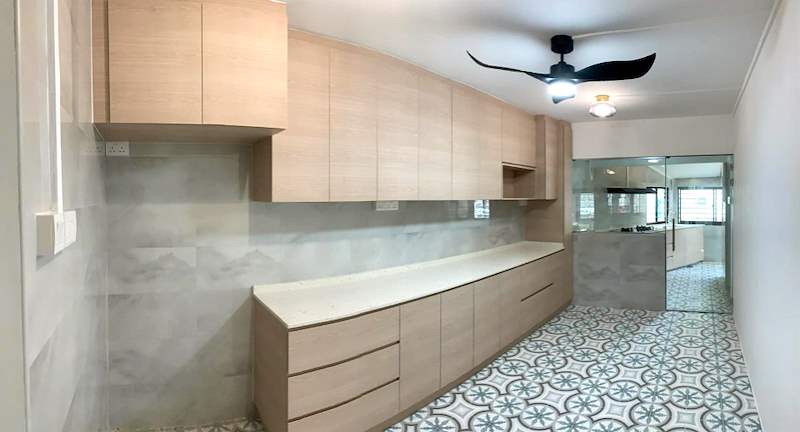
It usually starts with a sound. A sharp crack in the night, sometimes a run of them, and in the morning a row of floor tiles has lifted into a tent in the middle of the room. Or it is quieter than that: a patch of floor that sounds hollow when you walk across it, and a grout line that has started to crumble.
Either way, the same two questions follow. Who pays for this, and what does a proper repair actually involve? The first has a clearer answer than most people expect, especially in an HDB flat. The second is where money gets wasted.
First, the next hour
- Keep people off it. Lifted tiles have sharp edges, and a tented section can drop or crack further when someone steps on it. Keep children and elderly family members away from that part of the floor.
- Do not stamp it back down or glue it. A tile that has let go of its bed will not bond again by being pushed flat, and a quick DIY adhesive job only has to be dug out before the real repair can start.
- Photograph it, wide and close, before anything is moved. Whoever ends up dealing with it — HDB, a contractor under warranty, or you — dated photos are where that conversation starts.
- Keep the pieces, and check the storeroom for leftover tiles from when the floor was laid. Why that matters comes further down.
Why floor tiles pop
A tiled floor is three layers stuck together: the concrete slab, the bed of mortar or adhesive, and the tile itself. They do not expand and contract by the same amount when the temperature changes. When the stress between the layers is greater than the bond holding them, the tile lets go — and where tiles are packed tight with nowhere to move, they push against each other and lift.
That is not a contractor's theory. In a written answer to Parliament in January 2020, the Ministry of National Development (MND) said HDB received about 580 reported cases of dislodged floor tiles in December 2019, against a monthly average of 247 for that year. MND put it down to the colder weather and temperature fluctuations that month, which could have caused the tiles and the substrate to contract and expand at different rates, resulting in the loss of adhesion.
Temperature is the trigger, not the whole story. A tile that was never fully bedded — laid on dabs of mortar with voids underneath rather than on a full bed — has less bond to lose. A large floor laid tight from wall to wall has nowhere to relieve the stress. And a bed that has held for twenty years can simply reach the end of its life.
Who pays: ask who laid the tile, not how old the flat is
Most people start with the age of the flat. The more useful question is whose tile it is.
HDB flats with the tiles HDB provided
MND's written answers to Parliament in January 2020 and February 2021 set out HDB's position:
- Flat owners are responsible for the maintenance of their flats, including repairs for general wear and tear.
- Nevertheless, HDB will help flat owners repair dislodged tiles originally provided by HDB for a period of up to 15 years — which MND described as beyond the industry standard of one year.
- For flats more than 15 years old, owners engage their own contractors. HDB can provide a list of repair contractors to engage privately, and the 2020 answer added that HDB can help with removing and disposing of the affected tiles and, if necessary, laying protective sheets over the area.
- Residents who need financial help with the cost of the repair can seek assistance from grassroots organisations and the Community Development Councils, and HDB will refer them.
So if your flat is under 15 years old and the tiles that popped are the ones HDB put in, contact HDB before you call any contractor. Paying someone to fix it first may simply mean paying for a repair you did not need to pay for. Those answers date from 2020 and 2021, so confirm the current position with HDB for your own flat before you commit to anything.
Tiles laid during a renovation
This is the part that catches people out. HDB's help, as MND described it, is for tiles originally provided by HDB. A floor laid by your renovation contractor — or by the previous owner's contractor — is not HDB's tile, however young the flat is.
- If your own contractor laid it and the job is recent, it is a defect under your contract. Go back to the quotation and the warranty terms, send the dated photos in writing, and ask for a date to put it right. If that goes quiet, our note on defects when the contractor won't come back sets out the next steps.
- If the warranty has run out, or a previous owner put the floor in, the repair is yours to arrange.
There is a quiet consequence here for anyone renovating a flat that is still inside that 15-year window. Hacking out sound original HDB tiles and laying new ones swaps HDB's repair help on that floor for your own contractor's warranty instead. On our own jobs, the published warranty is one year. That is not a reason never to re-tile, but it is worth knowing before a perfectly sound floor is hacked purely for looks — the same trade-off covered in what to keep and what to hack in an older flat.
Condos and landed homes
HDB's position does not apply. In a newly completed private unit, raise it with the developer under the defects terms of your purchase while those still apply. After that, tiles inside your unit are yours to repair, unless they were laid by a contractor whose warranty still covers them. If the lifted floor is in common property — a corridor or lift lobby — that belongs to the MCST, not to you.
How a proper repair should be done
A repair that only replaces the tiles you can see standing up is often not a repair. The tiles around a popped section have been under the same stress, and some of them have usually already lost their bond without moving yet.
- Map the hollow area first. Tap outward from the popped tiles with a knuckle or a wooden handle. A dull, hollow note means that tile has let go. Mark the edge of the hollow area with masking tape. The repair — and the quotation — should be for that marked area, not for the number of tiles that happen to be lifting today.
- Take up everything inside the boundary, including the loose bed underneath, down to sound material.
- Lay the tiles back on a full bed rather than dabs, and leave room for movement at the edges and against the walls, so the repaired section is not locked in to fail the same way.
- Regrout, and keep weight off it until it has set. Pushing furniture back too early is an easy way to crack a fresh repair.
The matching problem
This is the practical headache. Tiles get discontinued, and even the same design from a different production batch can come out a slightly different shade. The options, best first:
- Spare tiles from the original job. Check the storeroom. If you are renovating now, ask your contractor to leave you a box of the floor tile for exactly this situation.
- Tiles lifted from somewhere nobody sees, such as the floor under a cabinet that can be taken out without damage, moved to the visible area.
- A deliberate contrast — a border, or a different tile across a clearly defined zone — so it reads as designed rather than patched.
- Re-tiling the whole room, when the hollow area is large or nothing comes close to matching.
Can you just lay vinyl over it?
Only once the loose area has been dealt with. Laying vinyl or new tiles over hollow tiles seals in a floor that is already letting go, and whatever goes on top moves with it. Take up the loose section and make it good and level first. After that, an overlay is a fair option for the rest of a sound floor — with the usual trade-offs of a raised floor level at doors and thresholds.
What the repair costs
A small patch repair depends almost entirely on the size of the area you marked, how easy it is to reach, and whether a matching tile exists, so it is priced after someone has actually looked at it. Our room cost calculator handles hacking and demolition the same way: quoted as a lump sum on a free site visit, because it depends on the existing condition.
If the answer turns out to be re-tiling a whole room, the tiling rate published in our HDB renovation cost guide is $5–$15 per square foot for supply and installation, from homogeneous tiles through to natural stone. Hacking out the old floor is priced separately from that.
Questions to ask before anyone lifts a tile
- Is my flat still under 15 years old, and are these the tiles HDB provided? If so, have I contacted HDB first?
- If a contractor laid this floor, is it still within their warranty, and have I sent them dated photos in writing?
- Has the whole hollow area been tapped and marked, and is the quotation for that area rather than for the tiles I can see?
- Will the old bed underneath be removed, and will the tiles go back on a full bed with room to move at the edges?
- Where is the matching tile coming from, and what is the plan if it does not match?
- If I am planning a renovation soon anyway, should this floor be folded into it rather than repaired now and again later?
Related reading
Hollow tiles come up in two other places on this site: the handover inspection before your final payment, where a hollow tile is cheapest to fix before the grout is sealed and the furniture goes in; and what to keep and what to hack in an older flat, where the same tap test decides whether a floor is worth keeping at all. For a floor your own contractor laid, start with defects when the contractor won't come back.
If tiles have popped in your home and you are not sure whether the repair is HDB's, your contractor's or yours, WhatsApp us on 9107 2601 with a photo and roughly how old the flat and the floor are. We will tell you who is most likely responsible and what a proper repair should cover. Larry Contractors is an HDB Licensed Renovation Contractor, HB-09-5667H; you can read how we work on our HDB renovation and direct contractor pages.