
Flooring Contractor in Singapore: Vinyl Overlay or Re-Tile an HDB Floor?
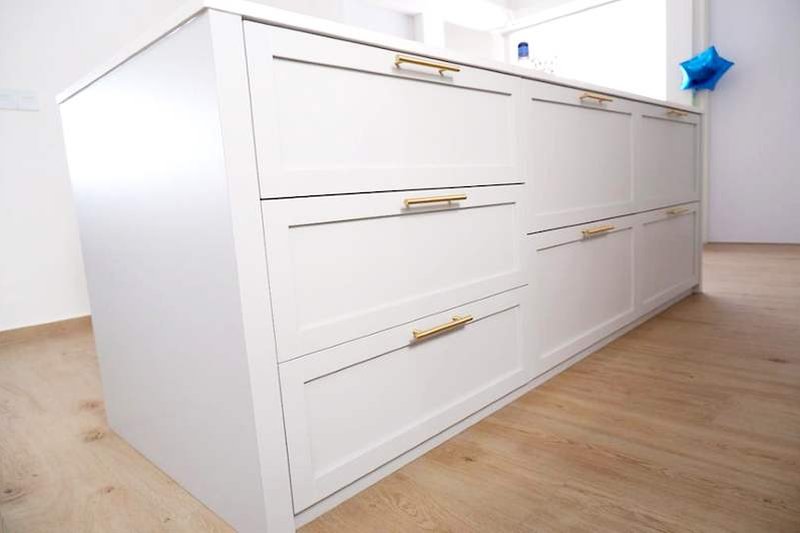
Pictured above: a light timber-look floor with skirting beside a white drawer unit, from our project archive (C05). A floor like this is a finish laid on top of a prepared base; what sits underneath decides how long it stays flat.
You are renovating a resale flat and the existing floor is tired. A flooring contractor offers you two routes: lay vinyl over what is there, or hack the old tiles out and lay new ones. The vinyl quote is a fraction of the tiling quote, so the cheap route looks obvious. Sometimes it is. But the two quotes are not pricing the same job, and the real question is not "vinyl or tile" but "what is wrong with the floor underneath, and what happens at the doors?"
This guide is for owners deciding between a vinyl overlay and full re-tiling for the dry areas of an HDB flat. It uses only the figures we already publish on this site, and it tells you what to check on the floor before anyone quotes.
The short answer
- Bedrooms and rooms with a sound, level floor: a vinyl overlay is the budget route and a fair one. Our 5-room cost page notes that many owners keep bedrooms on vinyl and reserve tiles for living areas and wet zones.
- Wet areas: this is not a vinyl decision. Our bathroom scope is waterproofing, a ponding test, then tiling. The choice in this article is about the dry rooms.
- A floor that is hollow, cracked or out of level: an overlay hides the problem rather than fixing it. Deal with the floor first.
- If you are hacking anyway for walls or a new layout: floor screed and making good are part of masonry, and re-tiling becomes easier to justify.
What our published figures say, and what they do not
We publish three different kinds of flooring number, and they answer different questions.
- Vinyl is a fixed package by flat type. In our room cost calculator, vinyl flooring including skirting is $4,000 for a 3-room, $5,300 for a 4-room and $6,500 for a 5-room flat. The calculator does not state which rooms a package covers, so ask what is inside it before you compare it with anything.
- Tiling is priced per square foot. On our HDB renovation cost pages, tiling runs $5 to $15 per square foot for supply and installation, from homogeneous tiles to natural stone. In the calculator, tiling labour is $11.80 per square foot including waterproofing and a 24-hour ponding test in wet areas, and standard porcelain is about $3.50 per square foot on top. These two measure different scopes, so do not add or average them. Our guide to what a per-square-foot tiling rate includes explains why.
- Hacking the old floor is a separate line. Our calculator quotes hacking as a lump sum on site because it depends on the existing floor and layout. Re-tiling a room therefore costs the tile and labour plus the removal of what is there.
As a rough feel for the tile side only, using the calculator's own method: 100 square feet of floor at $11.80 labour and $3.50 standard porcelain is about $1,530 before hacking, screed and skirting. That is a way to sense the shape of a quote, not a price, and the real figure follows a site visit. A vinyl overlay skips the hacking, and for many floors that is where most of the saving comes from. It is the reason vinyl overlay is the budget route in a basic refresh on our cost pages, while full re-tiling falls under the tiling rates.
Five checks on the existing floor before you choose an overlay
An overlay is only as good as the floor beneath it. Before you accept either quote, check these yourself. None of them needs tools.
- Tap for hollow tiles. Tap across the floor with a knuckle or the handle of a wooden spoon. A dull, hollow note means a tile has let go of its bed. Laying vinyl over hollow tiles seals in a floor that is already failing, and whatever goes on top moves with it. Our guide to popped and hollow floor tiles shows how to map the area and who pays for the repair.
- Look at the grout lines and the level. Deep grout lines, chipped edges and a floor that is not flat can show through a thin overlay as ridges and dips. Ask the contractor how they will level it, and whether levelling is priced.
- Check the floor level at every door. A new layer raises the floor. Look at how the doors swing and where the floor meets the next room. A raised floor can leave a step at a threshold or a door that now catches. Ask where the transitions will be and how they will be finished.
- Find where the vinyl stops. The wet-area floors are waterproofed and tiled, so the overlay ends at the bathroom door. Ask how that joint is finished so it does not collect water or lift at the edge.
- Ask who decides the floor finish, and when. Wardrobes and cabinets are built to fit the finished floor level. If the floor finish is still undecided when the carpentry drawing is signed, the drawing is wrong by construction, which is a point we cover in our guide to the order of works.
When re-tiling is the better call
Hacking out the floor and laying new tiles earns its extra cost in four situations:
- The floor is hollow over a large area. A patch can sometimes be repaired, but when the hollow area is large, or nothing in the flat matches the original tile, re-tiling the room is the honest fix.
- The floor is far out of level. Screed and making good after hacking are part of our masonry scope, and a new tiled floor is laid on a corrected base.
- You are changing walls, plumbing or layout. Once walls are hacked or pipes rerouted, the floor has to be made good anyway, so the saving from skipping the hacking shrinks.
- You want tile for durability in a high-traffic living area. That is a preference, and a legitimate one, but price it as a choice and not as a repair.
The catch most owners are not told: sound original tiles
If the floor is sound, hacking it out purely for looks has a cost that is not on any quotation. As we explain in our guide to popped floor tiles, repair help from HDB applies to HDB's own tiles within a set period. A floor laid later by a renovation contractor, yours or the previous owner's, is not HDB's tile however young the flat is. Hacking out sound original tiles and laying new ones swaps that help for your own contractor's warranty instead. That is not a reason never to re-tile, but it is worth knowing before a perfectly good floor is removed. We also cover the wider trade-off in our guide to what to keep and what to hack in an older flat.
The noisy part is regulated too. As our order-of-works guide notes, removing wall or floor finishes has to be done in a short window and cannot be done on Saturdays, Sundays or public holidays. Hacking a floor is therefore a scheduling item, not just a cost line, and it is one more reason a vinyl overlay can shorten the job. On our 4-room cost page a basic refresh runs about 2 to 3 weeks, against 6 to 8 weeks for a full renovation that includes hacking.
Questions to put on any flooring quotation
- Is this an overlay on the existing floor, or does it include hacking the old tiles? If hacking, where is it priced?
- Which rooms does the price cover, and does it include skirting?
- How is the existing floor checked for hollow tiles, and what happens if hollow patches are found after the quote?
- How will the floor be levelled, and is that included?
- What will the new floor level be at each door, and how are the thresholds finished?
- For tile: is the rate supply-and-install or labour only, and who pays if more tile is needed?
- Who handles the HDB permit? We handle the whole application on our HDB jobs, as an HDB Licensed Renovation Contractor, HB-09-5667H.
What to do this week
- Tap-test the floor in each room and tape off any hollow areas. Photograph them.
- Measure how much the floor can rise at each door before it catches.
- Decide room by room: vinyl for sound dry rooms, tile where the floor is failing or you want it for wear.
- Ask every contractor the seven questions above and compare the answers line by line, using our guide to reading and comparing renovation quotations.
Not sure whether your floor is sound? WhatsApp us on 9107 2601 with your property type, estate, flat type and a photo of the floor, and we will tell you what we would check first and arrange a site visit if you want one. You can also run your own rough numbers in the room cost calculator.