Floor Protection During an HDB Renovation, Singapore: Standard, Plywood or EVA Foam, and Which Floor Needs Which
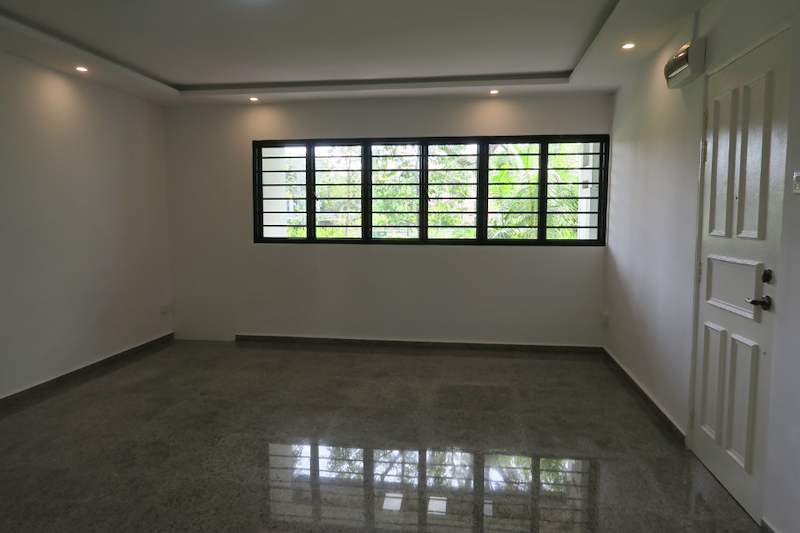
Pictured above: the living room of a resale flat from our project archive (C04), with a polished terrazzo floor. A floor like this is what a floor-protection line on a quotation is meant to look after.
The quotation arrives, and somewhere on it is a line that reads "floor protection". Or it does not, and you only find out that nobody covered the floor when you see a dragged scratch across it in week seven. Either way the owner usually has two questions and no way to answer them. What am I paying for? And does my floor need it?
This guide is for an HDB owner who has a quotation in hand, or is about to ask for one, and wants to know what floor protection is, which kind suits which floor, and what to get in writing. It uses only what this site already publishes: the floor-protection options in our room cost calculator, our 4-room programme, and the vinyl and painting figures from our other guides. We do not publish what it costs to repair a damaged floor, so we give no figure for that.
The short answer
- Our calculator lists three levels: standard protection at $500, heavy-duty plywood at $1,000, and heavy-duty EVA foam rolls at $1,000. You pick one, or none.
- The calculator pairs the material with the surface. Plywood is listed for hard surfaces such as tile and marble. EVA foam is listed for delicate surfaces such as timber and vinyl.
- It protects floors that already exist. The calculator's own wording is that it protects existing floors during works. A floor you are about to hack out does not need it. A floor you are keeping does.
- It is a separate line, not part of the painting figure. Our painting guide says so, and tells you to ask whether it is in or out.
- Get four things in writing: which floors, which material, whether it is priced or included, and who takes it up and puts it back.
What the calculator actually publishes
In the home section of our room cost calculator there is a card called Floor Protection. It says it protects existing floors during works, and you pick one option:
- Not needed. No line, no cost.
- Standard protection: $500.
- Heavy-duty plywood: $1,000. Listed for hard surfaces, tile and marble.
- Heavy-duty EVA foam rolls: $1,000. Listed for delicate surfaces, timber and vinyl.
That is all the calculator says. It does not state how much floor each option covers, how thick the material is, or what the standard option is made of. The calculator is an estimate, not a quote, so those details are exactly the things to ask about when someone prices your flat. What it does give you is the logic of the choice: the more delicate the floor, the more the material matters, and the two heavy-duty options cost the same, so the decision is about the surface, not the budget.
Why the surface decides the material
The calculator does not explain its pairing, so here is our reading of it, as plain reasoning rather than a published rule. A hard floor such as tile or marble is usually damaged by weight and impact: something heavy dragged across it, or something sharp dropped on it. A board laid over it spreads the load, which is what plywood does. A timber or vinyl floor is damaged differently: it marks, dents and scuffs under shoes, trolleys and the feet of cabinets, and a cushioning roll is a better fit for that than a hard board. Neither material makes damage impossible; they make it less likely.
The floor in the photo is polished terrazzo. Terrazzo is not named in the calculator's list, so we are not going to claim which option it takes. It is a hard, polished surface, and which option suits a surface the list does not name is a question for the site visit, answered by someone standing on that floor.
Which floors in your flat need it at all
This is the part nobody tells owners, and it depends entirely on the scope of the job.
A basic refresh keeps the floors. Our 4-room cost guide describes a bare refresh as paint, vinyl flooring and light carpentry with no hacking, at around $15,000 to $20,000 for a flat in good condition, and a basic refresh as taking 2 to 3 weeks. Nothing is stripped out, so every floor you walk on is one you are keeping, through painters and carpenters moving in and out. If you are keeping a timber or vinyl floor through a refresh, this is the job where the foam option is worth a conversation.
A full renovation replaces some floors and exposes the new ones. On our published 4-room programme, hacking is week 1, which removes the old tiles. Masonry, plumbing and electrical are weeks 2 to 3. Waterproofing and tiling are weeks 4 to 5. Carpentry installation is weeks 6 to 7, and painting, doors, hardware, sanitary fittings and handover are week 8. Read that against a new tiled floor. It goes down in weeks 4 to 5, and then carpenters bring in cabinets and wardrobes for two weeks, and painters follow in week 8. That is three weeks of other trades working on a floor that is new on day one.
Our order-of-works guide puts it plainly: every step that happens after a finished surface exists is a chance to damage it, and it lists whether the new floor gets scratched on day 40 among the things the order of the trades decides. So in a full renovation, the question is not only "is my old floor covered?" It is "is my new floor covered once the tiler has gone?" The calculator says its protection is for existing floors. Whether a new floor is covered after tiling is something to ask your contractor directly and have written down.
What it is worth next to the floor
For scale, and only as arithmetic on published numbers: our room cost calculator prices a vinyl floor including skirting at $5,300 for a 4-room flat. A $1,000 protection option is under a fifth of that. That is not a repair quote, and we do not publish one: the cost of fixing a floor depends on what is damaged and how. It only shows that the protection line is small next to the surface it covers.
Is it a line item or part of the overhead?
Owners often ask why one quotation charges for floor protection and another does not mention it. There are two honest answers, and our own guides touch both. Our calculator treats it as a visible option you choose by floor type, and our painting guide says it is not automatically part of a painting figure. Our guide on how to read and compare quotations, on the other hand, lists a separately charged "floor protection" among charges to question, on the view that standard preparation like this should be covered in the overheads.
What matters on your quotation is not which way a contractor books it. It is that you can see it. A quotation that says nothing leaves you guessing, and one that charges without naming the floors and the material gives you something you cannot compare. One that says "included, plywood on the tiled living room, foam on the timber bedroom floor" is the one you can hold someone to.
Floor protection is not lift and corridor protection
These get confused. Floor protection is about the surfaces inside your own unit. Lift protection and corridor or common-area protection are about the building. In a condominium the management office normally requires lift protection and holds a deposit against damage, as we cover in our guide to debris and waste disposal. Getting the lift covered does nothing for the floor of your flat, and covering your floor does nothing for the lift deposit. If you are in a condo, ask about both, separately.
What to get in writing
- Which floors are covered. Name the rooms. "Floor protection" with no rooms is not a scope.
- Which material on which surface. Plywood, foam, or the standard option, matched to the surface as the calculator pairs them, with your contractor's reasoning for any difference.
- Priced or included. A line with an amount, or a written statement that it is included. Not silence.
- Whether the new floor is covered after tiling. In a full renovation, the stretch between the tiler leaving and the carpenters arriving is where it matters.
- Who removes it and when. It should come up before the handover walkthrough, not after, so that you inspect the floor itself. Our handover inspection guide covers the walkthrough itself.
What it cannot do
Protection lowers the chance of a mark. It does not turn a heavy delivery into a gentle one, and it does not replace the other half of the job, which is a contractor who sequences the heavy and messy work before the finished floor exists. Our insurance guide makes the same point from the other side: almost all damage is prevented earlier, by the boring things, including a contractor who actually protects floors and lifts. If damage happens anyway, the written scope is what you fall back on, which is one more reason to have the floor named in the quotation.
The checklist
- Decide whether you are keeping each floor, or hacking it out.
- For each floor you keep, name its surface: tile, marble, timber, vinyl, terrazzo or other.
- Ask which of the three options your contractor would use on each, and why.
- For a full renovation, ask about the new floor after tiling.
- Check the quotation names the rooms, the material and whether it is priced or included.
- In a condo, ask separately about lift protection and the deposit.
- Agree who takes it up, and that it is gone before you do the handover inspection.
Planning a refresh or a renovation and not sure what your floors need? WhatsApp us on 9107 2601 with your flat type, your estate and what your floors are made of, and we will arrange a site visit. Any price depends on that visit. You can try the published options on the room cost calculator, see the published 4-room programme on the 4-room HDB renovation cost page, read how we work on our HDB renovation contractors page, and see more of this flat in our project photos.
Related reading: renovation order of works: which trade goes first and why · vinyl overlay or re-tile an HDB floor · what a painting rate covers and when to paint · renovation debris and waste disposal · handover inspection before final payment