
Buying a Resale Flat With Unapproved Renovation Works: What You Inherit
A resale flat that has already been renovated is easier to love at a viewing. The kitchen is open, the living room feels bigger than the floor plan suggested, there is a raised platform with storage under it, and none of it needs doing.
That is exactly the flat to slow down on. Not because renovated resale flats are a trap — most are perfectly fine — but because the paperwork behind the work is invisible, and under HDB's resale terms and conditions the responsibility for checking it sits with the buyer. Those terms describe a purchase made on a caveat emptor basis: it is the buyer's job to satisfy themselves that the works in the flat were authorised, and a buyer can be held responsible for unauthorised works that come to light later. A seller is expected to rectify unauthorised works before completion — but that expectation is not a substitute for looking.
So the practical position is simple and slightly unfair: whatever the previous owner did without permission becomes your problem once the keys change hands. Read HDB's own resale terms, and put anything doubtful to HDB or your conveyancing solicitor before you exercise the Option to Purchase, not after.
The paper trail a legitimate renovation leaves
Hacking works in an HDB flat require a renovation permit, and the permit is applied for by an HDB Registered Renovation Contractor — not by the flat owner. That is a useful thing to know as a buyer, because it means a properly done job has a named, licensed company behind it and a permit that exists somewhere. Larry Contractors Pte Ltd is an HDB Licensed Renovation Contractor, licence HB-09-5667H, and every permit we apply for is attached to that licence.
So the first question to the seller is not "was this approved?" — everyone says yes. It is: who did the works, and can I see the permit? A vague answer, a contractor nobody can name, or "it was done by the owner before us" is not proof of anything wrong. It is a reason to look harder.
What unapproved work actually looks like at a viewing
You are not going to spot everything, and you are not expected to. But these are the ones that come up repeatedly, and every one of them is visible in the twenty minutes you have in the flat.
1. A wall that is no longer there
The open-plan kitchen and the enlarged bedroom are the two most common alterations in Singapore flats, and both mean a wall came out. Some walls can be removed with a permit. Structural walls and columns cannot be removed at all, and that is not a paperwork problem that can be fixed later — it is a reinstatement problem. Our guide to which walls you can and cannot remove explains how to tell them apart, and the same reading works in reverse when you are inspecting someone else's work.
2. An extra bedroom
Partitions that turn a three-room layout into four, usually to let rooms out separately. The tell is a room with no window, or a door and architrave that do not match the rest of the flat, or a bedroom that is suspiciously narrow. Count the rooms in front of you against the rooms on the plan.
3. Raised floors and platforms
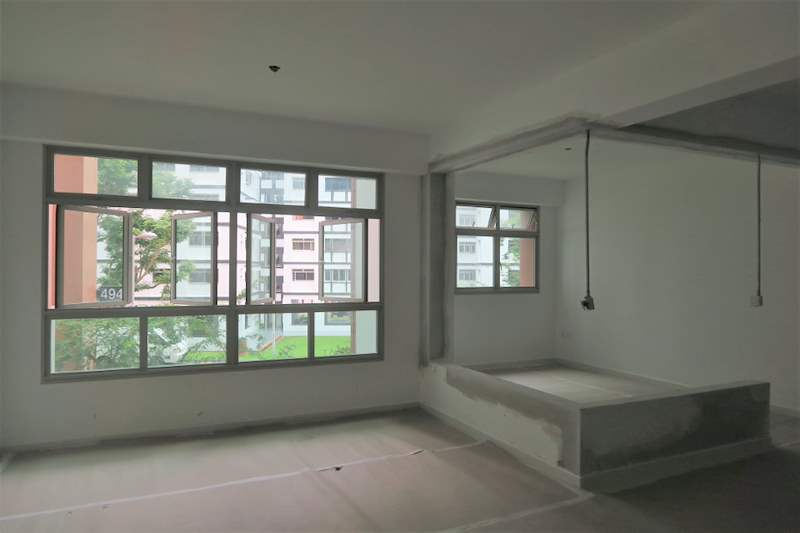
The photograph on this article is a flat stripped back mid-renovation, and the concrete plinth in the corner is the kind of thing that gets built in and then simply stays. Raised platforms, stepped floors and tiles laid over the original tiles more than once all add dead load and, in wet areas, sit directly on top of the waterproofing.
4. A bathroom that has been taken back to the shell
This is the expensive one to inherit, because the risk is not visible at all. The original waterproofing membrane in an HDB bathroom is the thing standing between your floor and your neighbour's ceiling, and a bathroom that was stripped and retiled by someone in a hurry may have had it damaged and never properly reinstated. Why bathroom waterproofing matters and what it costs covers what proper reinstatement involves. A leak that appears eighteen months after you move in is your leak.
5. Windows and grilles
Window works sit under their own approval regime, separate from the renovation permit, and are not something a general renovation crew can simply do. Changed window types, full-height glazing where the plan shows a standard casement, or grilles fitted in an unusual way are worth asking about specifically.
6. Enclosed service yards, ledges and bay windows
Boxing in the service yard to gain a store room, or enclosing an air-conditioner ledge, changes the flat's external envelope. It is also the alteration that is easiest to see from outside — walk round the block and look up at the unit before you go in.
7. Ceilings that hide the work
A full false ceiling is not a warning sign in itself. But it is where rerouted pipework, moved drainage and rewired circuits go to be invisible. If the flat has been comprehensively renovated and the ceiling is closed throughout, ask what is above it.
The five checks worth doing before you commit
- Get the original floor plan for that flat type and take it to the viewing. Almost every problem in this article is visible as a difference between the plan and the room.
- Ask for the renovation permit and the contractor's name, in writing, through the agent. The request itself is informative.
- Look at the bathrooms with the plan in hand. Same position, same size, same floor level as drawn? If not, ask when they were redone and by whom.
- Walk outside and look at the unit from the ground. Enclosures, changed windows and ledge alterations show up from there and nowhere else.
- Raise it before the Option to Purchase. This is the only one that is really about money. Before completion it is a negotiation — the seller rectifies, the price moves, or you walk away. After completion there is nobody to negotiate with.
If you already own a flat like this
Plenty of people discover the problem after moving in, usually when they start planning their own renovation and a contractor asks a question nobody asked before. Two things are worth saying.
First, do not start hacking out the previous owner's work on instinct. Establishing what was actually altered comes before deciding what to do about it, and "we removed it just in case" is how people spend money on the wrong thing.
Second, separate the two categories. Work that was simply never applied for is one situation. Work that touched structure is a different situation entirely, and it is not a paperwork exercise — it needs a proper opinion on what is there, not a contractor's reassurance.
Either way, reinstatement is the least satisfying money in renovation: you spend it and the flat looks like the plan it should have looked like all along. Which is precisely why the check belongs on the viewing, when it costs nothing.
The honest summary
Most renovated resale flats are fine. The ones that are not tend to look the best, because ambitious work is where corners get cut and permits get skipped. The buyer's advantage is that all of it is checkable in the twenty minutes before an offer, and almost none of it is checkable afterwards.
If you are viewing a flat and something does not match the plan, send us the plan and a few photographs. We will tell you what would have needed a permit and what would not, before you are committed to it. That is a question, not a job — we work directly with owners and would rather answer it early than be asked to reinstate it later.
Message us on WhatsApp about a flat you are viewing — send the floor plan if you have it.
Related: shelter finishes are a common form of unauthorised work and a common thing to inherit — see the HDB household shelter rules.
The same problem arrives without a seller to negotiate with when a flat comes to you through an estate - see renovating a flat you have just inherited.
Once the checks are done and the Option is exercised, the next question is timing: when you can actually start renovating a resale HDB flat, and what a seller's extension of stay does to that date.
Also worth reading: Renovate before selling your HDB flat, or sell as-is? — the seller's side of the same rule: what to fix or rectify before you list.