
Main Contractor in Singapore: Who Signs, Who Is on Site, and What to Ask About Subcontracted Trades
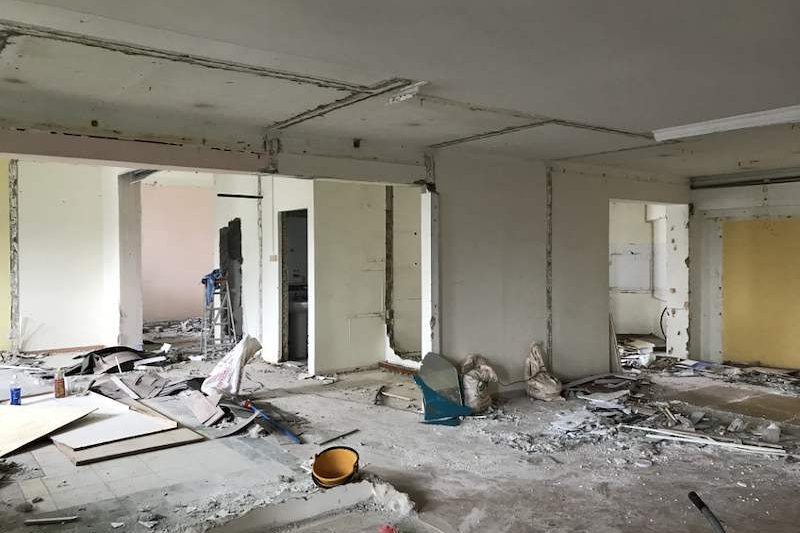
Pictured above: a flat taken back to its bare walls after demolition, from our project archive (C12). Before anything new goes in, several trades will pass through this room in turn, and one company has to be answerable for all of them.
Ask three homeowners what a "main contractor" is and you get three answers: the company that gave the biggest quote, the one with the licence, the one whose name is on the van. On a flat renovation it is simpler than that, and it is worth getting exactly right before you sign, because the main contractor is the party you will be calling on the day something goes wrong.
This guide is about one thing most quotations never state: who actually turns up. It uses only what our own pages and guides already publish, and it does not put a price on any of it.
The short answer
- The main contractor is the company you sign with. It holds the contract, applies for the permit, brings in the trades and answers to you for the finished work.
- Subcontracting is not a red flag by itself. Not being told who is subcontracted is.
- Ask for a one-page "who does what" list in writing before you sign: for each trade, our own team, a named licensed person, or another company.
- Four things must be the same company: the name on the quotation, the licence holder, the permit applicant and the payee.
What the main contractor actually does on a flat
In an HDB flat the renovation permit is applied for by the contractor, not by you, and only a company on HDB's register can apply. So someone on your job has to be that company, and that company is your main contractor. Its licence number takes the form HB-yy-nnnnn; ours is HB-09-5667H, and you can look any company up yourself on HDB's e-Services under "Find a Renovation Contractor". The full ninety-second check is in our guide to how to check that a contractor is HDB registered.
Beyond the permit, the main contractor is the one who does the unglamorous work a trade quotation never includes: putting the trades in order, making sure the regulated ones are done by the people the rules require, and being the single party you call when a joint leaks. We set out why that has a price in hiring each trade yourself or one general contractor.
There is a second, narrower meaning. Where works need BCA approval of plans, such as an extension or new structure, the main contractor carrying them out must be a licensed builder, which is a different credential from HDB registration. Renovation contractor or licensed builder explains where that line falls. For a flat, it is the HDB question that matters.
Subcontracting is not the problem. Not knowing is.
No single company does everything with its own hands, and some work cannot lawfully be done by just anyone. So a contractor who brings in a licensed person or another company for part of a job is behaving normally. What goes wrong is the version where the homeowner assumes one team and gets another, and nobody can say afterwards whose work a failed joint was.
The useful question is therefore not "do you subcontract?" but "who, for each trade?" A straight answer takes a minute. A vague one is an answer too.
The "who does what" sheet to ask for
Here is how ours is set out, as an example of the level of detail to expect from anyone. It is taken from what we already publish.
- Hacking and demolition: our own team.
- Tiling: our own team, after waterproofing has been applied and a 24-hour ponding test has been run. Tiling does not start before that test.
- Painting: our own team.
- Carpentry: built in our own carpentry factory in Singapore.
- Electrical: under HDB's guidelines this needs an EMA licensed electrical worker. The licence sits with a named person and we arrange it, as the rules require. A renovation contractor's licence does not replace it.
- Water supply plumbing: work on the water supply is for a PUB licensed plumber. Ask for the name.
- Gas: altering a gas pipe belongs to City Energy or a Licensed Gas Service Worker, not to the plumber.
- Window replacement: the one item we hand to an approved window contractor, and we plan the programme around that visit.
The point is not that every contractor should have our list. It is that yours should have one, and that it should name the licensed people for the regulated trades. Ask for it as a short message or a line on the quotation, so that it exists in writing. Our guides on electrical work, plumbing work and gas pipe works say who is licensed for what.
Five questions, in the order to ask them
- What is your registered company name and HDB licence number? Check it yourself before any money moves.
- Whose licence will the permit be applied under, and is that the company I am signing with? Ask it before you sign and keep the reply.
- For each trade on the quotation, who does it? Your own team, a named licensed person, or another company, and which one.
- Does your insurance cover subcontractors as well? Tiling, electrical and glass are frequently subcontracted, and a gap in cover sits exactly where the highest-risk work is. We explain what each policy does and does not do in what contractor insurance covers.
- If a joint between two trades fails, who do I call, and who puts it right? The right answer is one name: the main contractor.
Question five is the one that separates a main contractor from a coordinator. A leak under a bathroom floor could be the plumber's joint, the waterproofing or the tiler's work. If you hired each separately, each can point at the next. If one company is answerable for all three, it is one phone call. That is why waterproofing should be proven by a ponding test before tiling, and why someone has to own that test. We cover it in toilet waterproofing and the ponding test.
Four names that must match
Group structures are ordinary and not sinister by themselves. What matters is that you know exactly why any name differs. The four to compare:
- The company named on the quotation, which is who your contract is with.
- The company that holds the HDB licence.
- The company the permit will be applied under.
- The company or account you are asked to pay.
When these are one company, you know who to pursue and who is answerable to HDB. When they are not, ask why, in writing, before you sign. The reasons it can go wrong are laid out in the same HDB registration guide: working under someone else's licence, a quotation from a different entity, or a registration that does not cover your property type.
Where the money should follow the work
A main contractor who controls the sequence should be paid in the same sequence. Ask for a payment schedule tied to finished stages rather than to calendar dates, so that a slipping programme does not become your money problem. Why this matters, and how deposits and instalments are usually staged, is in renovation payment schedules.
On our published 4-room programme, hacking is week 1, masonry, floor screed, pipe rerouting and rewiring are weeks 2 to 3, waterproofing and tiling are weeks 4 to 5, and carpentry is weeks 6 to 7. Each handover from one group of people to the next is a point where a stage can be signed off before the next payment falls due.
Also ask for an itemised quotation, trade by trade. A single lump sum hides how many trades are in it and makes the "who does what" question impossible to check. We send an itemised quotation within three working days of the site visit.
Condo and landed homes
Condo. The management office often asks for the contractor's particulars, insurance details and a renovation deposit before it issues a permit, and the specific requirements come from that development's own by-laws. Get the contractor's insurance certificate early: a missing document is a routine reason for a permit application to sit. See condo renovation rules and MCST approval.
Landed. If the works need BCA approval, the licence that matters is a builder's licence, not an HDB one. Behind our building works sits Wong Lye Pte Ltd's BCA General Builder Class 2 licence. We say which credential applies to a job rather than implying one covers everything.
What to keep on file
- The registered company name and licence number, as given to you in writing.
- A screenshot of the HDB e-Services result, with the date visible.
- The "who does what" list, and the names of the licensed electrical worker and plumber.
- The approved permit, and the works description on it.
- The quotation and every payment record, all in the same company name.
That folder is what turns "I think they said they did it themselves" into something you can act on if a dispute ever starts.
Comparing contractors, and not sure who will be on your site? WhatsApp us on 9107 2601 with your property type, the scope and the quotations you hold, and we will tell you what a "who does what" list for your job should name. Any price depends on a site visit. You can read how we work on our direct contractors page, see what we are licensed to carry out on our HDB renovation contractors page, and see more of this flat in our project photos.
Related reading: what "direct contractor" means in Singapore · each trade yourself or one general contractor · how to check HDB registration · what contractor insurance covers · HDB window replacement and the approved window contractor