
Renovation Contractor or Licensed Builder in Singapore: Which One Your Job Needs
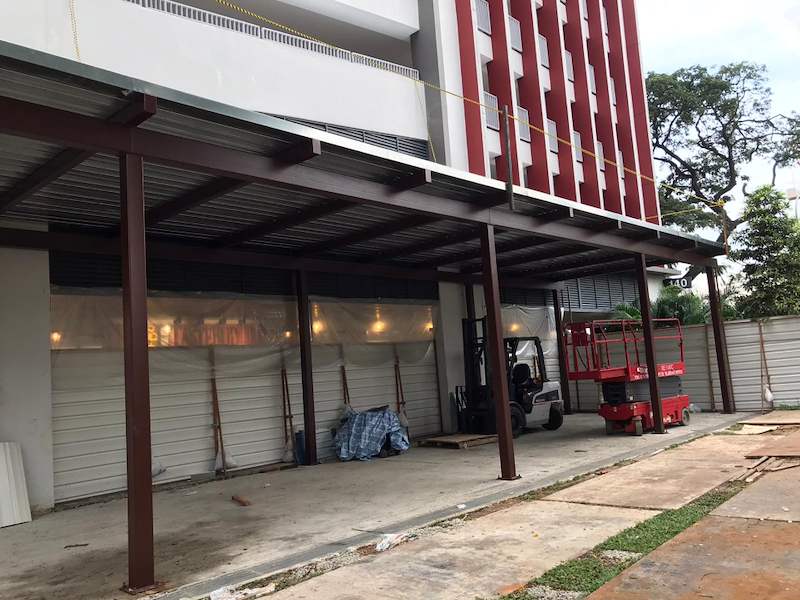
Pictured above: a covered dining extension for a coffee shop under an HDB block, from our project archive (140CD), with the steel frame and roof deck up during works. A new structure like this is building work, not renovation, and that difference decides who is allowed to build it.
Search for a builder in Singapore and you get renovation companies. Search for a renovation contractor and you get builders. Most people use the two words as if they mean the same thing, and for most home renovations nothing goes wrong because of it.
But in Singapore they are not the same thing in law. A renovation contractor and a licensed builder hold different credentials, from different authorities, for different kinds of work. Hire the wrong one for a kitchen and you have probably overpaid. Hire the wrong one for an extension, a new slab or a steel mezzanine and you can end up with works nobody was entitled to carry out, and a problem that surfaces when you sell, insure or try to get the next approval.
This is how to tell which one your job needs, and what to ask before you sign.
Three credentials that get blurred together
When a company says it is licensed or registered, it could mean any of three different things. They are not interchangeable.
- HDB registration. HDB keeps its own register of renovation contractors, and only a company on it may apply for a renovation permit for works in an HDB flat. The licence number looks like ours: HB-09-5667H. It is about HDB flats specifically.
- A BCA builder's licence. Under the Building Control Act, a builder carrying out building works whose plans need approval from BCA must hold a builder's licence. There are general builder licences (Class 1 and Class 2, where Class 2 is limited to projects of $6 million or less) and specialist builder licences for specialist works such as piling and structural steelwork. A licensed builder must also have an Approved Person and a Technical Controller in charge of its works.
- BCA's Contractors Registry. A separate BCA scheme that registers contractors for public-sector projects, by type of work and financial grade. It is useful for what it is, but it is not a builder's licence, and a company can hold one without the other.
So "BCA registered" on a website or a van is not a complete answer. Registered for what? The question that matters for your job is whether it needs a licensed builder, and if so, whether this company is one.
The one question that decides it
Strip everything else away and the test is simple: do the works need BCA approval of plans?
If they do, a Qualified Person (an architect or professional engineer, depending on the work) designs and submits them, and the main contractor carrying them out must be a licensed builder. If they do not, a licensed builder is not legally required, and a good renovation contractor is the right hire.
Roughly, the line falls like this. Treat it as a guide to the conversation, not a ruling on your particular job — the QP decides where a specific piece of work sits.
Usually renovation work:
- Carpentry, built-in wardrobes, kitchen cabinets
- Tiling, flooring, painting, false ceilings
- New non-structural partition walls
- Bathroom and kitchen refits, with waterproofing, plumbing and electrical done by the licensed trades
- Hacking non-structural walls in an HDB flat, under HDB's permit
Usually building work that brings BCA in:
- Extensions to a landed house, and additional floors
- Removing or altering a structural wall, beam, column or slab
- New openings through a structural slab, such as a new internal staircase
- New structures: a covered area like the one pictured, a car porch roof, a steel mezzanine in a commercial or industrial unit
- Strengthening works on an existing structure
The trap is the second list dressed up as the first. "We are just adding a small room at the back" and "we are just putting a platform in the warehouse" are sentences that sound like renovation and describe building works.
What changes when a licensed builder is needed
It is not only a different company. It is a different process, and it takes longer at the front:
- A QP is appointed to design the works and prepare the drawings. On a landed house that usually means an architect, with a professional engineer for the structure.
- Approvals come before anything is built. Structural plans go to BCA. On landed property, work that adds floor area or changes the outside of the house will usually need URA planning permission as well.
- The licensed builder carries out the works under the QP's supervision, and the works are inspected as they go.
- Completion is documented. That paperwork is what a buyer's lawyer, a bank or the next contractor will ask for years later.
If a quotation for an extension does not mention a QP, plan submission or approvals anywhere, it has either left them out of the price or left them out of the plan. Neither is good news.
By property type
HDB flat. Almost everything is renovation work under HDB's rules, done by an HDB registered contractor with a permit where needed. Structural walls cannot be removed, the household shelter cannot be touched, and a builder's licence rarely comes into it. What matters here is HDB registration.
Condominium. Interior works go through the MCST's approval and house rules. Anything structural brings BCA in on top, with a professional engineer, and many MCSTs will not entertain it at all. Check both before you design around it.
Landed house. This is where the two worlds meet. A landed interior renovation is renovation work. The moment the job includes an extension, a new floor, a new roof structure or a structural wall coming out, part of it is building work and needs a licensed builder. Many landed projects are both, which is why the interface between the two matters.
Commercial and industrial units. A fit-out of partitions, ceilings and finishes is renovation work, with the landlord's rules and the fire-safety submissions that come with it. A mezzanine, a new floor opening or an external structure is building work, and should be treated as such from the first drawing.
Where people get caught
The borrowed licence. A renovation company quotes for an extension, wins the job, and brings in a licensed builder somewhere down the line to put a name on the paperwork. On paper, a licensed builder is responsible. On site, the people doing the work may have little to do with it. Ask directly: which company is the builder named in the submission, and is that the company I am signing with?
Starting before approval. The pressure to start is real, especially on a landed house where the family has already moved out. Structural work done ahead of approval is the kind of problem that does not stay buried. It surfaces at sale, at the next submission, or when something cracks.
Two contractors, one house, no owner of the gap. On a landed job with both building and interior work, the builder finishes the structure and the interior contractor starts on finishes. If nobody owns the handover, the gap is where the leaks, the uneven floors and the arguments live. Decide early who is responsible for what, and in writing.
The wrong question at quotation. Asking "are you licensed?" gets you a yes. Asking "which licence, and for which part of my job?" gets you an answer.
How to check, in ten minutes
- For an HDB flat, look the company up on HDB's e-Services under Find a Renovation Contractor and match the licence number.
- For building works, look the company up in BCA's online directory of registered contractors and licensed builders, and note whether it is a general builder or a specialist builder, and which class.
- Check the company name on the quotation matches the name on the register exactly. A brand name is not a company.
- Ask who the QP is for any structural element, and whether the submission has been made or is still to come.
- Ask for the scope to be split in the quotation: what is building work, what is renovation work, and who carries each.
A company that is set up properly answers these without hesitation. Hesitation is the answer.
How we handle it
Larry Contractors Pte Ltd has renovated Singapore homes and commercial spaces since 2009 and is an HDB Licensed Renovation Contractor (HB-09-5667H). Our parent company, Wong Lye Pte Ltd, is a BCA General Builder Class 2 (GB2) licensed builder, and structural A&A work goes through them. So when a landed or commercial job turns out to be part renovation and part building work, you are not left to find and coordinate a second company on your own. More on that on our about page, our landed renovation and commercial renovation pages, and how we work as a direct contractor.
Not sure which side of the line your job is on? Tell us what you want to change and we will tell you what it needs before anyone draws anything. WhatsApp us on 9107 2601.
Related reading: how to check a contractor is really HDB-registered · design and build vs architect plus contractor · bungalow renovation vs rebuild