
What "Direct Contractor" Actually Means in Singapore
Type "direct contractor" into Google in Singapore and it is usually easy to guess why. Someone has just been quoted by an interior design firm, the number was higher than they hoped, and a friend has told them to "just get a direct contractor, it's cheaper." That advice is half right. The half that is wrong is where people lose money. Here is what the term actually means in the Singapore market, what you are and are not getting, and how to check that the person calling themselves a direct contractor really is one before you sign anything.
The phrase is not a licence, a grade or a legal category. Anyone can print "direct contractor" on a name card. So the first thing to understand is that it describes how a firm is set up, not how good or how cheap it is, and the second is that you have to verify it yourself. This post covers both.
What "direct contractor" actually means
On our own direct contractor page we put it plainly: a direct contractor handles your entire renovation project, from design consultation to the actual building work, without any intermediary. That last phrase is the whole point. You are dealing with the firm that will physically hack, wire, tile, waterproof and build the carpentry in your home, not a company that wins your job and quietly passes it to someone else.
The reason the term is tied to a lower price is real, and we publish the figures ourselves. Going direct typically saves 15–30% of total project cost compared with using an interior designer: on a $50,000 renovation, that is $7,500 to $15,000 saved. That is not a discount and it is not a promotion. It is the design-firm commission that you are no longer paying on top of the actual building cost. The building work costs roughly the same either way; what changes is how many parties take a cut of it. Our HDB packages, for the same reason, start from $18,000.
What you are getting, and what you are not
Going direct is a trade, not a free lunch. It is worth being honest about both sides so you choose with your eyes open.
- You get direct pricing. One firm quotes the building work and does the building work. There is no second margin sitting on top.
- You get one accountable party. When a tile lifts or a wardrobe door drops, there is no argument about whether it is the designer's fault or the builder's. It is the same company.
- You get a shorter chain. The person who quoted you is close to the people holding the tools. Decisions on site get made faster.
- You do not get a full-time stylist. A good direct contractor still designs, space-plans and advises on materials, but the emphasis is on what builds well and lasts, not on a magazine shoot. If elaborate 3D mood boards and a dedicated designer curating every finish is what you want, an interior design firm is selling exactly that, and charging for it.
- You do not automatically get "licensed" or "cheap". "Direct" only describes the structure. A direct contractor can still be unlicensed, and a lump-sum "direct" quote can still be more expensive than a properly itemised one once the missing items are added back.
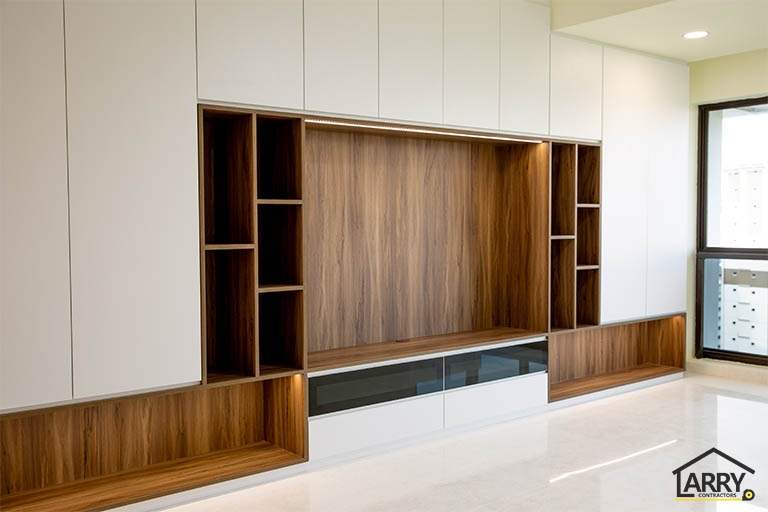
The living-room carpentry in the photo above — full-height wardrobes, a timber feature wall and a low bench — is the kind of work a genuine direct contractor builds with its own team and its own factory, rather than farming out to a joinery shop it has never met. That is the practical difference you are paying less for: fewer hands between you and the finished job.
Three checks that prove a contractor really is "direct"
Do not take the words on the name card. Three checks, all of which you can do before you commit, settle it.
- Check the HDB licence. For any HDB flat, the renovation permit is applied for by the contractor, not by you — the owner cannot lodge it. Only a firm on HDB's Directory of Renovation Contractors can. Ask for the licence number and look it up. Ours is HB-09-5667H. Our guide on how to check an HDB registered renovation contractor shows exactly where to search. A firm that cannot give you a number, or gives one that does not match its name, is not the party that will be building your flat.
- Ask for a written, itemised quotation. A real direct contractor can price the work line by line, because it is the one doing each line. Hacking, disposal, electrical, plumbing, waterproofing, tiling, carpentry, painting — each should have its own figure. A single lump sum with no breakdown usually means someone has not yet worked out who is doing what, which is the opposite of "direct".
- Ask who supervises and whose workers are on site. "Who is my point of contact once works start, and are the crew your own or a subcontractor's?" A direct contractor will answer without hesitation. If the answer is vague, you are likely talking to a middleman, and the price advantage you came for has already gone to whoever is actually doing the work.
The two traps
Most bad direct-contractor experiences are one of these two.
The middleman who says "direct". This is a salesperson or a small outfit that takes your job and subcontracts every trade, adding a margin in between — exactly the intermediary you were trying to avoid, just wearing the word "direct". The tell-tale signs: no licence number, evasiveness about who does the work, a lump-sum quote with no breakdown, and different unmarked crews turning up with no consistent supervisor. You get the middleman markup and lose the single point of accountability.
The quote that is cheap because it is incomplete. The lowest number in your inbox is often lowest because it leaves things out, not because the firm is more efficient. The items most commonly missing from a thin "direct" quote are hacking and debris disposal, electrical rewiring on older units, waterproofing and the ponding test in wet areas, haulage and lift protection, and the permit itself. Adding them back later — as "variation orders" mid-job, at the contractor's price — is how a cheap quote becomes the expensive one. Our guide on how to read and compare renovation quotations shows how to line two quotes up so you are comparing the same scope, not two different ones.
Direct contractor or interior design firm?
Neither is "better" in the abstract; they suit different people. If you value the lower cost and are comfortable making finish decisions with a builder who thinks in terms of buildability, direct is the sensible choice. If you want a designer to own the styling end to end and are happy to pay for that service, an ID firm is what you are describing. We set the two side by side, honestly, in direct contractor vs interior design firm.
Before you sign: a checklist
- Have I been given an HDB licence number, and does it match the firm's name in HDB's directory?
- Is my quotation itemised line by line, or is it a single lump sum?
- Do the quotes I am comparing cover the same scope, including hacking, disposal, rewiring and waterproofing?
- Do I know who supervises on site and whether the workers are the firm's own?
- Is the "cheapest" quote cheapest because of price, or because it left things out?
- Am I clear on what a direct contractor gives me and what an ID firm would give me instead — and which one I actually want?
Want us to price it directly?
Send us what you are planning and we will give you an itemised quotation and our HDB licence number up front, so you can check both before we ever talk about a deposit. WhatsApp us on 9107 2601. Larry Contractors is an HDB Licensed Renovation Contractor, HB-09-5667H; you can read how we work on our direct contractor and HDB renovation contractor pages.