
General Contractor or Hire Each Trade Yourself? What Running Your Own Singapore Renovation Takes
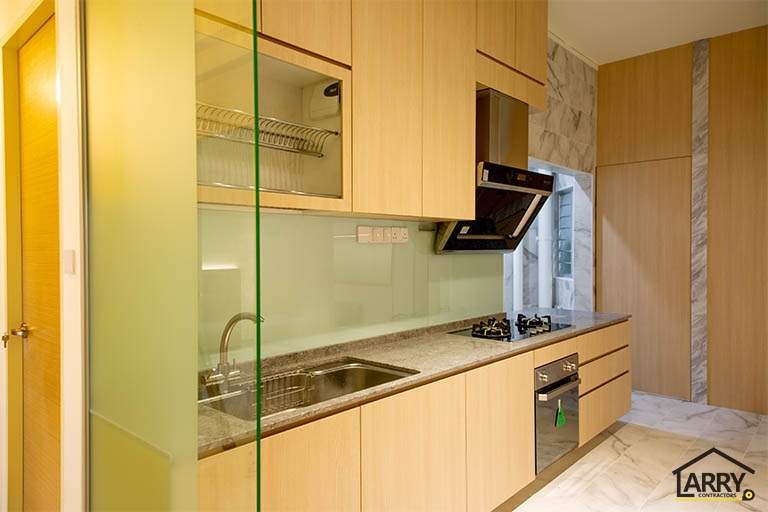
Pictured above: a kitchen from our project archive (C12). Every fitting in it belongs to a different trade, and all of them had to be finished in the right order before it looked like this.
Sooner or later every homeowner does the sum. The plumber quoted one number, the electrician another, a carpenter a third, and the contractor's all-in figure is higher than the three added together. So why not hire each trade yourself and skip the main contractor?
Sometimes that is a fair call. But the gap between the two prices is not a margin for nothing. It is the price of someone else doing a job that the trades' quotations do not include: making sure they arrive in the right order, that the permits exist, and that somebody is answerable when it goes wrong. Here is what that job actually is, what you take on if you keep it, and the questions that show what a general contractor really does.
What you are buying from a general contractor
A general contractor does not just build. It carries four things that no individual trade will carry for you:
- The sequence. Hacking, then plumbing and electrical first fix, then waterproofing and its test, then tiling, then carpentry, then painting. Each trade can only start when the one before has finished.
- The paperwork. In an HDB flat the renovation permit is applied for by the contractor, not by the owner, and only a company on HDB's register can apply. So someone on your job has to be that company.
- The licensed trades. Some of the work cannot lawfully be done by just anyone, and somebody has to find and coordinate the people who can.
- The defect. When something fails, there is one party to call, instead of a plumber and a tiler each saying it was the other.
The kitchen test
The fastest way to see the coordination job is to count what meets in a single kitchen like the one above.
- Hacking and disposal. The old cabinets, tiles and screed come out, and the debris has to leave the building properly. Removing it is part of a contractor's job, not household waste.
- Plumbing. Sink supply and waste. Work on the water supply is for a PUB licensed plumber, and the waste fall is decided before the screed goes down. More on that in our guide to plumbing work in a renovation.
- Electrical. Hob, oven, hood, sockets, lighting. Under HDB's guidelines electrical work needs an EMA licensed electrical worker, a named person holding a licence that a renovation contractor's licence does not replace. See electrical work in a renovation.
- Gas. If the hob is gas, altering the gas pipe is not the plumber's job either. It belongs to City Energy or a Licensed Gas Service Worker, as we set out in gas pipes and your kitchen renovation.
- Waterproofing and tiling. Waterproofing goes on, is tested, and only then does the tiler start.
- Carpentry. Cabinets are drawn around the appliances, so the hob, oven and hood sizes have to be known before anything is cut.
- Worktop and splashback. Both are cut to a template, and the template can only be taken once the cabinets are in.
- Painting and final fittings. Last, once everything above is finished.
Eight steps, up to three of them regulated, and every one depends on the step before it. That is one kitchen. A full flat has the same chain in each wet area, plus the rest.
What you take on if you run the trades yourself
None of these is impossible. All of them become yours.
1. The permit. For works that need an HDB renovation permit, you cannot lodge it yourself. You would still need an HDB registered contractor to apply for it, which means hiring one anyway, for some of the work. Check how to do that in how to check that a contractor is HDB registered.
2. Finding every licensed person. An electrical worker, a plumber, possibly a gas service worker, and for window replacement a separate approved window contractor with its own permit, as in HDB window replacement. Each one is a search, a check and a booking.
3. The calendar. Trades are booked in blocks across several jobs, so a two-day slip at one step usually becomes a wait for that trade's next opening. A main contractor absorbs this by managing it daily. If you are managing it, it is your evenings and your weekends, which we describe in what to do when your renovation runs late.
4. The gaps between trades. The classic dispute is the leak that could be the plumber's joint, the waterproofing or the tiler's work. With one contractor, it is one phone call. With four, each one points at the next, and you are the only person who hired all of them.
5. Supplying and checking. Whoever coordinates also receives deliveries, stores them and checks them. We have written about where this goes wrong in buying your own materials, and the same logic applies to buying labour by the trade.
6. The test that nobody owns. Waterproofing is only proven when the floor is ponded and left before tiling. If the waterproofer, the plumber and the tiler are three separate hires, nobody is obliged to insist on it. We run a 24-hour ponding test before any tiling starts. Someone on your job has to make that call, and if it is not a contractor, it is you.
When running it yourself does make sense
We would rather be straightforward about this than pretend every job needs a main contractor. Hiring directly is reasonable when the job is a single trade, needs no permit, and does not hold up another trade. Replacing a worktop, fitting a single wardrobe or repainting a room are the obvious examples.
It stops making sense the moment two trades depend on each other, anything is hacked, or anything is regulated. A bathroom redone from the floor up is all three, and so is a kitchen. Those are the jobs where the coordination is the main cost.
Six questions to ask any general contractor
- Which company holds the HDB licence, and is it the company named on the quotation? Ours is HB-09-5667H, and you can look it up yourself.
- Who is the licensed electrical worker, and who is the licensed plumber, for my job? A straight answer is a good sign, and a vague one is an answer too.
- Which of these trades are your own people, and which are brought in? Both are legitimate. Not knowing is not.
- Who does the waterproofing test, how long does it run, and is it before tiling?
- Is the quotation itemised trade by trade, so I can see what each one costs? A single lump sum makes the comparison with hiring trades directly impossible.
- Is my payment schedule tied to finished stages rather than to dates? That is what keeps a slipping programme from becoming your money problem.
How we run it
Larry Contractors Pte Ltd is an HDB Licensed Renovation Contractor, HB-09-5667H. We have our own carpentry factory, and our own teams for hacking, tiling and painting, so the carpentry and the sequence sit under one roof. For the regulated work, such as electrical installation, the licence sits with a named person and we arrange it, as the rules require. Window replacement is the one item we hand to an approved window contractor, and we plan the programme around that visit.
We send an itemised quotation within three working days, so you can set it beside the trade quotes you already have. The fairest way to decide whether the gap is worth paying is to see exactly what it covers. Read how we work on our direct contractors page, or what we are licensed to carry out on our HDB renovation contractors page.
Holding trade quotations and not sure whether to go direct or through a contractor? WhatsApp us on 9107 2601 with your property type, the scope and the quotes you have, and we will tell you which parts you could sensibly hire yourself and which you should not. Any price depends on a site visit.
Related reading: buying your own materials · when your renovation runs late · HDB window replacement