
Dining Pendant Light in an HDB Flat, Singapore: Fix the Point Over the Table Before the False Ceiling and the Table Are Chosen
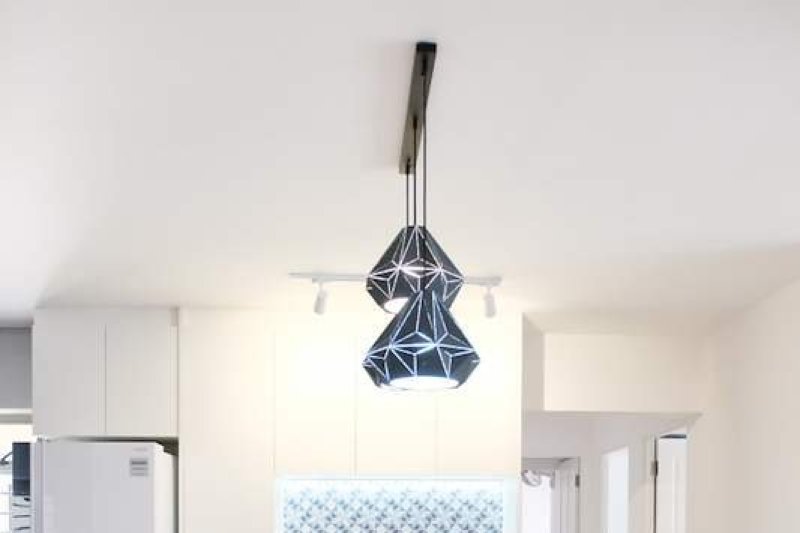
Pictured above: the dining area of a flat from our project archive (407B). Two black geometric shades hang on cords from a bar fixed to the ceiling, and a white track with two spotlights sits just beside them. The pendant's position over the table is the part that had to be fixed before the ceiling was finished.
A dining pendant is one of the few lights that must be in exactly the right place. A downlight can sit a little to the left or right and nobody notices. A pendant that hangs half a table-width off centre is the first thing every guest sees. Yet in most renovations it is chosen last, after the table is bought and the ceiling is already painted, and by then the only point available is wherever the electrician left one months earlier.
This guide is for an owner of an HDB flat who wants a pendant, or a pair of them, over the dining table. It uses only what this site publishes: the 4-room programme and the electrical and ceiling rates on our room cost calculator. We do not publish a price for a pendant light or for a ceiling bar, so none is given here.
The short answer
- Decide where the dining table will stand before the electrician wires. The pendant point is placed over the table, not over the middle of the room. Mark the table's footprint on the floor with tape and stand in it.
- Know the pendant, or at least the type, before first fix. One shade on one cord, two shades on a bar and a long linear light each need a different point or fixing. Ask the seller for the installation sheet.
- Decide the fixing and the point in weeks 2 to 3, while the ceiling is open to the electrician. The ceiling closes in weeks 4 to 5.
- Decide how it is switched, and whether it needs a dimmer, before the cable is run.
Why the pendant point is not like the other lights
Most lights in a flat are placed on a grid: a light point every so often, the downlights spaced evenly across the ceiling. The pendant breaks that rule. It belongs to the table, and the table belongs to the dining area, which in a lot of HDB layouts is a spot you define by furniture and not by walls. In an open living and dining space, nothing on the ceiling tells you where the dining area stops. The pendant's point is the thing that tells you.
That makes it a decision about the room, not about the light. Where you eat, which way the table runs, how many chairs go on each side and how far the table sits from the kitchen counter all decide where the point has to be.
Find the point with tape, not a drawing
A drawing on paper rarely shows how a table sits in the real room. Before the electrician comes, do this at the flat, even when it is still a bare shell:
- Mark the table's outline on the floor with masking tape, at its real size. If you have not bought the table, use the size you are most likely to buy.
- Mark where the chairs sit when pulled out, because people need to get in and out and the pendant should not be in the way of anyone's head.
- Stand in the middle of the tape and look up. Where does the point need to be so the light is over the table and not over the walkway beside it?
It takes ten minutes. It gives your contractor a position that can be measured from two walls, not a vague "over the table".
One shade, two shades or a bar
The picture shows two shades on cords of different lengths, fixed to a bar on the ceiling. That bar matters. It carries both cords from one point and lets the shades hang apart. A single shade needs only a single point over the table. A cluster of several shades can mean one point and a canopy, or several separate points, depending on the fitting. We do not know which your pendant needs until we see its sheet, so the honest advice is the same as for any other fitting: ask for the installation sheet before the ceiling is drawn.
What you want from that sheet, in plain terms:
- How it is fixed. Does it screw into the ceiling, into a bar, or into a canopy plate? A pendant is a hanging weight, not a light that sits flush, so ask what it is fixed to.
- How the cord length is set. Some pendants are adjustable, some are cut to length. Find out whether the length can be changed after installation, because a table you have not bought yet may be taller or lower than the one you expect.
- The shade width. A wide shade over a narrow table or a narrow shade over a long one both look wrong. The sheet gives the width, and you can compare it to the tape on the floor.
The point, the wiring and the switch
On our published 4-room programme, masonry, plumbing and electrical work fall in weeks 2 to 3, and the programme describes the electrical scope as full rewiring. The false ceiling and the concealed aircon trunking come in weeks 4 to 5. That is the window for the dining point, and it is a short one.
- Where the cable ends. The cable for a pendant ends in a box at the point over the table. Move the table by a foot after the ceiling is closed and the pendant is off centre, with no easy fix.
- Which switch runs it. A dining pendant is often wanted on its own switch, or on a dimmer, separate from the living room lights, because you eat under it and watch television in the next room. Our guide to light switches and light points makes the case for every switch in the flat: where it goes is decided before the ceiling closes, because moving a switch later means opening the wall.
- Whether it needs a dimmer. A dimmer needs a compatible bulb and a compatible control. Ask which the pendant allows before the cable is run.
What goes wrong when the pendant is left late
Three failures are easy to see coming, and each one starts with leaving the pendant until last.
- The point is over the walkway. If the table is bought after the ceiling is closed, its position can turn out a little different from the one imagined. The pendant then hangs beside the table instead of over it.
- The fixing is not strong enough for the fitting. The point was wired for a light, and a heavier pendant was chosen afterwards. Whatever the pendant hangs from must suit the pendant that will hang there. We do not publish a load figure for any fixing and will not invent one, so ask your contractor to name the fixing on the drawing, as in our post on ceiling fans.
- The ceiling is not the shape you assumed. If you have a perimeter drop or a full false ceiling, the pendant hangs either from the higher centre or from below the board, and that decides the cord length and where the fixing sits. Our post on whether a flat needs a false ceiling covers the layouts.
The pendant and the cabinet beside it
In the picture the pendant hangs over a table that sits in front of a full-height white cabinet and a backlit display niche. That arrangement shows why the point cannot be chosen alone. The cabinet's position, the niche's own light and the track spotlights beside the pendant were all drawn together. If the carpenter's drawing is done first and the pendant point later, the pendant can end up too close to the cabinet face. Ask for the pendant's position to be put on the carpentry drawing, so that the two are checked against each other before anything is built.
Where it sits in the programme
On our published 4-room programme, a full renovation runs like this.
- Week 1: hacking and demolition.
- Weeks 2 to 3: masonry, plumbing and electrical. The dining point, its cable and its switch are wired here.
- Weeks 4 to 5: waterproofing, tiling and ceiling. The ceiling closes, and any fixing the pendant needs has to be in before it does.
- Weeks 6 to 7: carpentry installation. The cabinet by the dining area goes in here.
- Week 8: painting, doors and hardware, deep cleaning and the handover walkthrough. The pendant itself can arrive late, but its point cannot.
What it costs
We do not publish a price for a pendant light, for its fixing or for a dimmer. What is published on our room cost calculator is $90 for a light point, $90 for a power point and $4.80 per sq ft of floor area for a false ceiling. None of these is a price for your pendant. Ask how your quotation counts the dining point, who supplies the pendant, and whether the fixing and the switch are inside the electrical figure or priced apart. What it costs depends on the fitting and on a site visit.
Questions to put on the drawing and the quotation
- Where is the dining table drawn, and is the pendant point measured from two walls?
- Which pendant is this drawn for, and is its installation sheet attached?
- What is the pendant fixed to, and is that fixing in place before the ceiling closes?
- Does the pendant need a dimmer, and is its switch on the electrical drawing?
- Is the pendant's position on the carpentry drawing as well, so the cabinet beside the table and the pendant are checked together?
- Does the quotation include the pendant, and is the fixing inside the electrical figure or separate?
We are an HDB Licensed Renovation Contractor, HB-09-5667H. Planning a pendant over the dining table? WhatsApp us on 9107 2601 with your flat type, your estate and the pendant you have in mind, and we will arrange a site visit to go through the point, the fixing and the order of works. Any price depends on that visit. The published programme is on our 4-room HDB renovation cost page, you can run the published electrical and ceiling rates on the room cost calculator, our work is described on the HDB renovation contractors page, and you can see more of this flat in our project photos.
Related reading: light switches and light points · a ceiling fan in an HDB living room · whether an HDB flat needs a false ceiling · the TV console wall · a kitchen island or peninsula