
Renovating Before a Baby Arrives in Singapore: Work Back From the Due Date, and What to Settle in the Flat
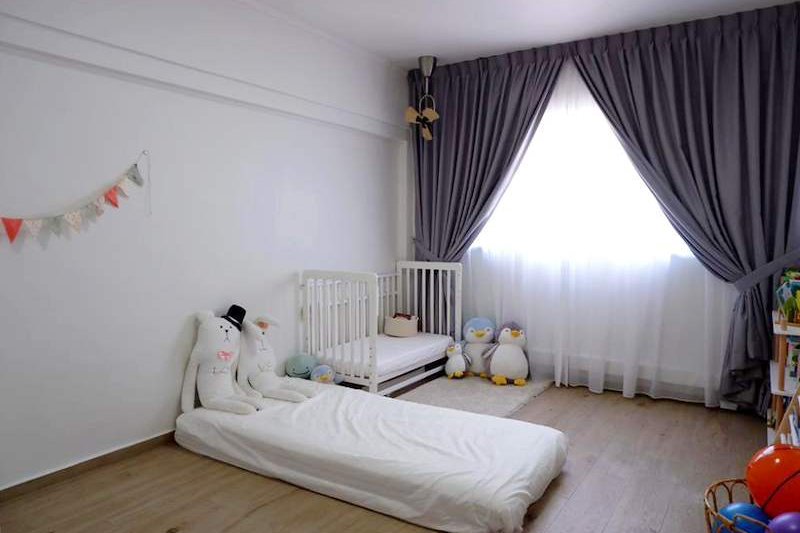
Pictured above: a bedroom set up as a nursery in an HDB flat, with a white cot, a floor mattress and curtains over the window, from our project archive (C05). A room like this still depends on what was settled behind the walls: where the sockets are, where the aircon blows and what is on the floor.
Most renovations have a flexible finish date. A renovation before a baby arrives does not. There is a date after which you will be in the flat whether the work is done or not, and the date is not entirely in your hands. So the first job is not choosing a colour or a cabinet. It is counting backwards from the day you need to be living there, and being honest about how much of that time the renovation can use.
This guide is for an HDB owner renovating before a baby arrives. It uses only the programme lengths and paint packages already published on this site. It does not tell you what is safe for a baby, because that is a question for your doctor and the product maker, not for a contractor. What it covers is the part we do know: the order work happens in, what has to be settled before the walls close, and what can wait until after.
The short answer
Do not count back from the due date. Count back from the day you need to be living in the flat, which is earlier, and leave room for a slip. Then spend your decisions on the things that sit behind a surface (electrical points, aircon positions, the bathroom floor and waterproofing), because those cannot be changed cheaply once the flat is closed up. Furniture, curtains and most of the carpentry can follow.
Step one: count back from the day you need to move in
Write the dates in this order, from the last to the first.
- The day you need to be living in the flat. Pick it earlier than the due date. A due date is an estimate, not an appointment.
- The time you want between handover and that day. Your handover walk-through leaves a list of items to put right, and then there is the clean-up and the move itself. Put your own number on this. We do not publish one, and it depends on how much is on your list.
- The renovation programme. On our cost pages a full 3-room renovation runs about 4 to 6 weeks, a full 4-room 6 to 8 weeks and a full 5-room 8 to 10 weeks. A basic refresh with no hacking is about 2 to 3 weeks on the 4-room page.
- The time before the programme starts. The renovation permit, the quotation, the drawings and the orders for made-to-measure items all come first.
Here is how that works as arithmetic, using only the published figures. If you need to be living in a 4-room flat by a given Monday, and the work is a full renovation, the programme alone is up to 8 weeks. That means the work has to start at least 8 weeks before the handover, and that is before the handover list, the clean and any slip. Our guide to what to do when a renovation runs late explains why a small slip early in the programme becomes a large one by the end, because each trade moves to its next opening. A slip is the one thing a baby date cannot absorb.
If the numbers do not fit, you have three honest options: start earlier, cut the scope, or split the job. The second and third are covered below.
Step two: cut the scope to what must be finished first
A full renovation for a baby date is often the wrong job. The question to ask is which work must be finished before you move in, and which can be done later with you living there.
Our guide to renovating in two stages sets out the rule: work that goes behind a surface has to happen first, and work that sits on top of a surface can usually wait. For a baby date, the dusty, noisy and wet work is the part you do not want to be living with. Hacking, new wiring, plumbing, waterproofing and tiling belong before the move. A wardrobe, a TV console and a shoe cabinet can come later.
There is a middle route too. If the flat does not need hacking, a basic refresh is the short programme: painting, vinyl flooring and light carpentry, about 2 to 3 weeks on the 4-room page. Our guide to a 3-room flat: refresh or full renovation lists the five checks that decide which one you need.
What to settle before the walls close
These are the decisions that are cheap now and expensive later. None of them needs a price from us to decide.
- Where the cot, the bed and the changing area go. Draw the baby's room to scale before the electrician marks anything. Then mark the power points, switches and any light against that drawing. A socket drawn behind a cot is a socket you cannot use. Our guide to electrical work and the licensed electrical worker explains why points are decided before first fix, when adding one is nearly free, not after the walls are skimmed.
- Where the aircon indoor unit goes. Aircon positions have to be settled before the false ceiling closes. For a baby's room, draw where the cot will be and decide where the unit blows, before the pipe route is fixed. Our guide to aircon piping and ledge placement covers the timing.
- The bathroom floor and the waterproofing. The floor finish is a choice you make before the tiles are ordered, and the published process is waterproofing, then a 24-hour ponding test, then tiling. Ask to see the tile wet before it is laid, as we suggest in our guide to a safer home for elderly parents, because a glossy tile that is fine dry can be slippery wet for anyone. Our guide to the ponding test says what to ask before tiling.
- The shape of the carpentry. Ask for the edges and corners of low carpentry to be drawn as you want them, such as softened rather than sharp, and have it written on the drawing. We do not publish whether this changes the price, so ask for it to be stated on the quotation.
- The floor. Our published vinyl packages are $4,000 for a 3-room, $5,300 for a 4-room and $6,500 for a 5-room flat, including skirting. The calculator does not say which rooms a package covers, so ask. Our guide to the vinyl overlay or re-tile choice lists the checks on the old floor first.
Paint and the time after painting
Painting is one of the last trades in. On our 4-room programme it sits in week 8, with doors, sanitary fittings and cleaning, just ahead of the handover walk-through. That is useful to know: the paint is fresh in the last days of the job, so the time between the final coat and the day you move in is the time you have to let the flat air.
Our calculators price four whole-home paint packages by flat size. For a 4-room flat they are $2,050 for anti-mould, $2,150 for washable, $2,300 for the odour-less all-in-1 and $2,450 for premium, all with one undercoat and two overcoats. The odour-less package is marked as the most popular, and the washable one suits a home with young children where you expect to wipe marks off. We do not make health claims about any paint. Ask for the manufacturer's own product sheet for the paint you choose and read it. The wider choice is in our guide to painting and what the rate covers.
What can wait until after
- Most of the carpentry that is not in the baby's room, such as a console or a shoe cabinet.
- Curtains, furniture, and any feature wall.
- The loose items you will not know you need until the baby is here.
The rule is the same as before: leave the points, pipes and positions ready now, so the later work does not mean opening a finished wall. If you do split the job, plan the later stage with the noise rules in mind. Our guide to renovation noise rules covers permitted hours, because drilling next to a sleeping baby is a different problem from drilling next to nobody.
If you are already living in the flat
Some owners have no choice but to stay. That changes the order of work more than the scope: a live zone kept clear, one bathroom at a time, and no day when the only toilet is out of action without a plan. We cover it in renovating while living in the flat. If a baby is already in the home, or is about to be, treat that guide as the starting point and tell your contractor before the programme is written.
Where it goes wrong
- The count starts from the due date, not from the day you need to be in the flat, so the first slip uses up the whole margin.
- The full scope is kept when the date only allows the work behind the walls.
- The cot is placed after the points and the aircon were fixed, so the socket is behind it and the unit blows straight onto it.
- The handover list is left to "later", and the flat is lived in with unfinished items on it. Our guide to the handover inspection says how to do it before the final payment.
Questions to put in writing
- What is the programme for my flat type and scope, week by week, and what date does it finish if it starts on the date we agree?
- Which trades are the ones most likely to slip, and what happens to the finish date if one does?
- Which items are in the first stage, and which are in the second? Please list them.
- Will you mark the electrical points and aircon position against my drawing of the baby's room before the walls close?
- What is the floor finish in the bathroom, and can I see it wet before it is laid?
- Will the corners and edges of the low carpentry be softened if I ask, and is that shown on the drawing and in the price?
- When is the handover inspection, and how long after it are the listed items put right?
What to do this week
- Write down the day you need to be living in the flat, and put it earlier than the due date.
- Count back using the programme lengths above, and see whether a full renovation fits.
- Draw the baby's room to scale and mark where the cot, the changing area and the aircon will go.
- List what must be finished before the move, and what can wait.
We are an HDB Licensed Renovation Contractor, HB-09-5667H. Working to a date? WhatsApp us on 9107 2601 with your flat type, your estate and the date you need to be living there, and we will tell you plainly whether the programme fits and arrange a site visit. Any price depends on that visit. The published programme and figures are on our 4-room HDB renovation cost page, and our other renovation services are on the HDB renovation contractors page.
Related reading: renovating in two stages · what to do when a renovation runs late · order of works