
Old Terrazzo Floor in a Resale HDB Flat, Singapore: Polish It, Cover It with Vinyl, or Hack and Re-tile
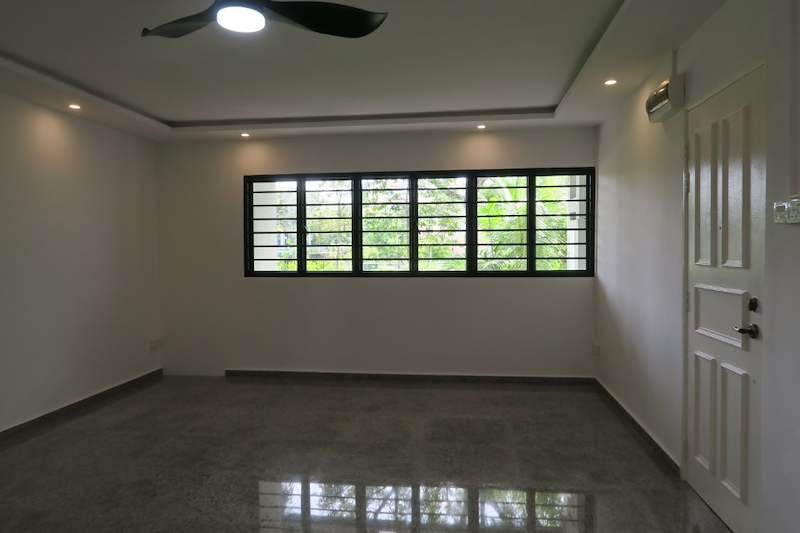
Pictured above: a living room from one of our resale HDB projects (C04) after renovation, with a polished terrazzo floor reflecting the window, a dark skirting strip along the wall and a cove ceiling with a fan light. The before photos of the same flat show the original terrazzo under the old fittings.
Many older resale HDB flats still have their original terrazzo floor: small chips of stone set in cement and ground smooth. After decades it is usually dull, stained and patched. You have four ways to deal with it, and owners who decide by looks alone find the knock-on costs later: at the doors, the wardrobes and where a wall used to stand.
This guide uses only figures already published on this site.
The short answer
- Keep it and polish it if the floor is sound: no hollow patches, no large cracks, and no big areas that have been replaced with something else. You keep the original level, so doors, skirting and carpentry are not affected.
- Cover it with vinyl if it is sound but you want a different look for less money. Vinyl is laid over the existing floor, so the floor underneath still has to be firm and level.
- Tile over it if you want tiles but the terrazzo is sound. This raises the floor more than vinyl does, so the doors and thresholds need more attention.
- Hack it out and re-tile if large areas are hollow or broken, or you are already hacking walls and moving pipes and the floor has to be made good anyway.
Whichever route you choose, settle it before the carpenter draws anything. Wardrobes, kitchen cabinets and doors are made to fit the finished floor level.
What our published figures cover, and what they do not
These are lines we already publish. Nothing below is new.
- In our room cost calculator, vinyl flooring including skirting is $4,000 for a 3-room, $5,300 for a 4-room and $6,500 for a 5-room flat. The calculator does not say which rooms a package covers, so ask.
- Also in the calculator, tiling labour is $11.80 per square foot, including waterproofing and a 24-hour ponding test for wet areas, and standard porcelain tile is about $3.50 per square foot on top if you have us supply it.
- On our HDB renovation cost pages, tiling runs $5 to $15 per square foot for supply and installation, from homogeneous tiles through to natural stone. The two tiling figures measure different scopes, so compare like with like on any quotation.
- Hacking and demolition are quoted as a lump sum on the free site visit, because they depend on the existing floor and layout. Masonry covers floor screed, kerbs and making good after hacking.
- Floor protection in the calculator is $1,000 for heavy duty plywood, listed for hard surfaces such as tile and marble, or $1,000 for heavy duty EVA foam rolls, listed for delicate surfaces such as timber and vinyl.
- All works carry our 1-year warranty.
We do not publish a price for polishing or restoring a terrazzo floor. The condition of the floor decides the work, so that price is agreed after we have seen it.
Five checks on the terrazzo before you choose
None of these needs tools.
- Tap for hollow areas. Tap across each room with a knuckle or the handle of a wooden spoon. A dull, hollow note means the floor has let go of what is underneath. A hollow area is a problem for every route except hacking: polishing does not fix it, and vinyl or tile laid over it moves with it. Mark hollow areas with tape and photograph them.
- Look for cracks and old patches. Long cracks, a strip of cement where a wall once stood, or a square of a different floor where a pipe was repaired. Polishing makes a floor shine, but it does not hide a patch. A repair rarely matches the chip mix of the original floor, so if you plan to keep the terrazzo, decide whether you can live with the patches you see.
- Check the level. Lay a long straight edge, such as a spirit level or a length of timber, across the floor in a few directions. A floor that dips or rises will show through vinyl as a soft spot and makes tiling over it harder.
- Look at every door and threshold. Vinyl and tile both raise the floor. Look at how much gap each door has at the bottom, where the terrazzo meets the kitchen and bathroom floors, and at the main door. A raised floor can leave a step at a threshold or a door that catches.
- Look at the skirting. Many terrazzo floors have a matching skirting strip along the wall base, as in the photo above. Polishing keeps it. Our vinyl package includes skirting, so ask how the new skirting is fitted against the old one, and whether the old strip stays.
Route one: keep it and polish it
This keeps the floor at its original level, so nothing else in the flat has to change to suit it.
What to watch:
- The floor has to survive the rest of the renovation. Every other trade works on top of it: hacking, carpentry installation, painting. Terrazzo is a hard floor, so it sits on the plywood side of our floor protection list. Ask for the protection to be on the quotation, and ask when the polish is done in the programme, before or after the heavy trades, and how the floor is protected after it.
- Polishing is noisy, messy work. Our cost pages list noisy work such as hacking, tile cutting and heavy drilling as weekdays 9am to 5pm only under HDB's renovation hours. Ask how the polishing is scheduled within the permitted hours and how long it takes for your floor.
Route two: cover it with vinyl
Vinyl over a sound floor is the budget route on our cost pages, part of a basic refresh. A bare refresh of paint, vinyl flooring and light carpentry with no hacking is about $15,000 to $20,000 if the flat is in good condition, and on our 4-room cost page a basic refresh takes about 2 to 3 weeks against 6 to 8 weeks for a full renovation.
The catch is that the terrazzo is still there underneath. Every hollow patch, crack and dip has to be dealt with before the vinyl goes down, and the vinyl stops at the wet areas, which are waterproofed and tiled. Our guide to vinyl overlay or re-tiling an HDB floor goes through those checks in detail.
Route three: tile over it
Our cost pages list a tile overlay as an option in a basic refresh, as well as vinyl. It avoids hacking out the terrazzo, but it raises the floor more than vinyl does, because the tile sits on its own bed. Doors may need trimming, and the main door and the thresholds to the kitchen and bathrooms need a clear plan.
Route four: hack it out and re-tile
This is the heaviest route and the one that solves the most. It earns its cost when large areas are hollow, when the floor is badly out of level, or when you are already changing the layout.
For a rough feel of the tile side only, using our calculator's own method: 100 square feet of floor at $11.80 labour and $3.50 standard porcelain is about $1,530, before hacking, screed and skirting. That is arithmetic from our published rates, not a quotation. The hacking itself is quoted on site, and our cost pages note that a resale flat with hacking adds $5,000 to $15,000 against the BTO equivalent, because older units need more rewiring and waterproofing as well.
The catch most owners miss: the strip where a wall used to stand
If you plan to remove a non-structural wall (our cost pages put hacking one at $800 to $1,500, with the HDB permit handled by us), there is usually no terrazzo under it, because the floor was laid up to the wall. Once the wall is gone, a strip across the floor has to be filled. If you were planning to keep and polish the terrazzo, that strip will not match the floor either side, however carefully it is done.
So decide the walls and the floor together. If a wall is coming out of a terrazzo room, either accept a visible strip, plan a feature such as a different floor band across the opening, or cover that room's floor. Our guide to which HDB walls you can remove covers the wall side of that decision.
Decide the floor before the carpenter draws
Wardrobes, kitchen cabinets, shoe cabinets and doors are made to fit the finished floor. If the drawing assumes the terrazzo stays and you later decide on a tile overlay, the doors may catch and full-height cabinets may no longer fit under the ceiling or bulkhead. Write the floor route for each room on the drawing before you sign off the carpentry.
Questions to put in writing
- Which route is priced for each room: polish, vinyl, tile overlay, or hack and re-tile?
- How has the floor been checked for hollow areas, and what happens if more are found after work starts?
- For polishing: what does the price include, how long does it take, and when is it done in the programme?
- How is the terrazzo protected during the other works, and is the protection on the quotation?
- For vinyl or tile: what will the new floor level be at each door, and how are the thresholds and skirting finished?
- If a wall is coming out, how is the strip of floor under it finished?
- What does the 1-year warranty cover on the floor work, in writing?
What to do this week
- Tap-test every room and tape off the hollow areas. Photograph them, along with any cracks and patches.
- Mark any walls you want removed, and decide what happens to the floor under each one.
- Choose a route for each room and ask for each room to be priced as its own line.
We are an HDB Licensed Renovation Contractor, HB-09-5667H, and we handle the whole HDB permit application on our HDB jobs. Not sure whether your terrazzo is worth keeping? WhatsApp us on 9107 2601 with a few photos of the floor and we will tell you what we would check first and arrange a site visit. Any price depends on that visit. The flooring, tiling and protection rates are on our room cost calculator, the published hacking and tiling ranges are on our 3-room HDB renovation cost page, and you can see the finished flat in our C04 project photos.
Related reading: vinyl overlay or re-tile an HDB floor · floor protection: plywood or EVA foam · which HDB walls you can remove