
Buying a Landed House in Singapore: Renovate, Add and Alter, or Rebuild?
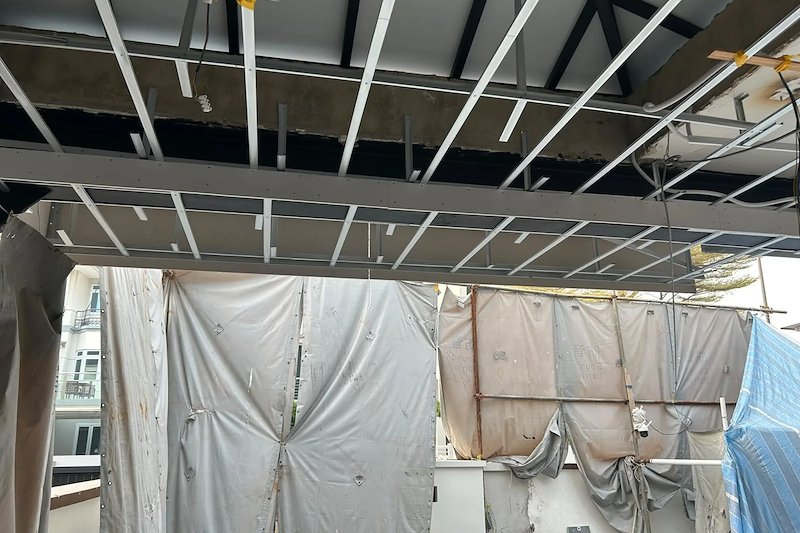
Pictured above: ceiling framing going up inside a three-storey semi-detached house we are renovating, with the building still wrapped in protective sheeting. This is what "renovate" means on a landed house that has already been standing for years: you work inside a structure you did not build.
You have found a landed house you like. The asking price is one number. What the house will cost you by the time you can live in it is another, and the gap between them depends on a decision most buyers make too late: do you renovate it, add and alter it, or knock it down and rebuild? Make that call after you have signed and you are choosing from whatever the plot and the building allow. Make it before, and you can price the house for what you are actually going to do with it.
Here is how the three routes differ, what each one costs and how long it takes by our published figures, and the checks to make while you can still walk away.
The three routes, and what each one really is
- Renovate (interior only). The structure stays as it is. You change kitchens, bathrooms, floors, ceilings, carpentry, lighting and paint. Our published range for interior-only landed work is $50,000 to $150,000, depending on the number of rooms and how much carpentry there is, and it typically takes 3 to 4 months.
- Add and alter (A&A). You change the building itself: an extension, an extra room or storey, roof work, a car porch, a boundary wall, a pool, a lift. Interior plus A&A works run $150,000 to $350,000 by our published range and typically take 5 to 7 months. The approval process adds 2 to 4 weeks at the start, and longer for major structural changes.
- Rebuild. Most of the old house comes down and a new one goes up. Our published range for a full rebuild or major reconstruction is $300,000 to $500,000+, and a rebuild or extensive extension can run 9 to 12 months or longer.
Those are ranges, not quotes. Landed houses vary so much that we do not price one without a site survey, and neither should anyone you are comparing us with. Use the ranges to see which route you are in before you ask anyone for a number.
Notice that the ranges overlap. A heavy interior job and a light A&A job can cost much the same. What separates the routes is not the cheque, it is the approvals, the structural work and the time the house is out of use.
Question one: how much of the house can you keep?
The cheapest route is almost always the one that leaves the structure alone, so the first thing to judge is whether the structure is worth keeping. Walk the house looking for signs the building is tired rather than just the finishes:
- Cracks in walls and beams, especially wide ones, and especially where an old extension meets the original house.
- Damp staining on ceilings and the tops of walls, which usually points to a roof or a drainage problem rather than a paint problem.
- Floors that slope or feel springy.
- Extensions that look different from the main house. These are the parts most likely to have been built without the paperwork anyone should have lodged.
If the problems are on the surface, a renovation fixes them. If they run through the structure, the honest answer may be that you are buying the land and the old house is a cost to be removed, not an asset. That is the buyer's version of the question, and it is why a structural opinion before you commit is worth far more than a nicer set of photos.
Question two: what are you allowed to build on this plot?
This is where most disappointed buyers get caught. Singapore landed properties are governed by URA's Master Plan, which sets the allowed gross floor area (plot ratio), height limits and setback requirements for the zone. An extension that exceeds the plot ratio cannot be approved. That is not a negotiation, and it is the reason we check the Master Plan for your zone before designing any extension or additional storey.
For a buyer, the practical meaning is simple. An older house on a generous plot may have room left to build, and that room is part of what you are paying for. A house that already uses everything the plot allows has none, and a seller's "you can always extend" is only worth anything if a Qualified Person confirms it on paper. Get the maths done by a QP, meaning a registered architect or structural engineer, before you exercise the option, not after. The option period is short, so line up that person before you start viewing, not when you are holding the paperwork.
Ask the seller for the approved plans and any record of past additions. Then compare them with what you can see standing on the plot. If there is a room, a roof or a cover on site that is not on the plans, find out why before it becomes your problem.
Question three: who is allowed to do the work?
Renovation and A&A are not the same job in the eyes of the rules, so the builder you can use depends on which route you pick. For A&A works we coordinate the submissions to BCA for structural plans and to URA for any plot ratio, height or external changes. The drawings come from our partner Qualified Persons, who are registered structural engineers and architects. Our parent company, Wong Lye Pte Ltd, is a BCA-registered General Builder Class 2 (GB2), which covers these projects up to the contract values that grade allows.
Whoever you speak to, ask the same questions: who submits, who signs, and which licence covers the value of this contract. Our guide on renovation contractor or licensed builder sets out how to tell which one your job needs.Question four: what does the house cost you while it is not livable?
A route is not only a price. It is a number of months with two homes to pay for, or one home and a building site. An interior-only job at 3 to 4 months, an A&A at 5 to 7 months and a rebuild at 9 to 12 months or longer are three very different periods of rent or mortgage overlap. Put the months into your sum next to the contract price. A cheaper route that gets you in earlier can be the more affordable one overall.
The rebuild route also has a neighbour cost that does not appear on any quotation. On our live jobs page you can follow a landed reconstruction through its early stages: demolition done slowly so debris stays on our side of the boundary, noise barrier sheeting around the perimeter, a noise monitoring device on the hoarding, skid tanks hauling the rubble out, then a surveyor setting out levels before piling begins. Every one of those steps takes time before a single new wall exists, and it is why a rebuild's programme is measured in most of a year.
How to decide, in order
- Find out what is approved and what is actually there. Get the plans, walk the plot and note every difference.
- Get a QP to tell you the remaining plot ratio and the setbacks. That sets the ceiling on what any route can deliver.
- Judge the structure, not the finishes. Ask for a structural opinion if there are cracks, damp or sloping floors.
- Pick the lightest route that gives you what you need. Renovate if the building is sound and the layout works. Add and alter if it is sound but too small. Rebuild if the structure is the problem or the plot allows far more than the house uses.
- Price the months as well as the contract. Add the time you will pay twice.
- Then ask for a site survey and a written quotation. Not before, and never from a range on a web page, including ours.
What goes wrong when buyers skip this
- Buying for a plan the plot cannot take. The extension that sold you the house exceeds the plot ratio, so it is never approved.
- Budgeting a renovation for a house that needs A&A. The first quote comes in at a different range, and the money is not there.
- Treating an unapproved past addition as an asset. Find out before you buy what it would take to put right, because that cost lands on the new owner.
- Counting only the contract. The months you cannot live in the house are real money.
How we help before you decide
Larry Contractors Pte Ltd is an HDB Licensed Renovation Contractor, HB-09-5667H, and we handle landed work from interior refreshes to A&A. We will go through a house with you on site and tell you which of the three routes it points to, so you know what you are really buying before you sign. Our landed renovation contractors page lists what we do, and our guides on A&A works for landed homes, renovation versus rebuild for current owners, landed extensions, how long a landed renovation takes and landed renovation costs go deeper on each route.
Looking at a landed house and not sure which route it needs? WhatsApp us on 9107 2601 with the address or the listing, the house type and what you want from it, and we will arrange a site visit. Any price depends on that visit.
Related reading: landed home extension guide · how long a landed renovation takes · renovation contractor or licensed builder · bungalow renovation vs rebuild