
Floodlights and Outdoor Lights on a Landed House in Singapore: What to Settle Before the Soffit Is Painted
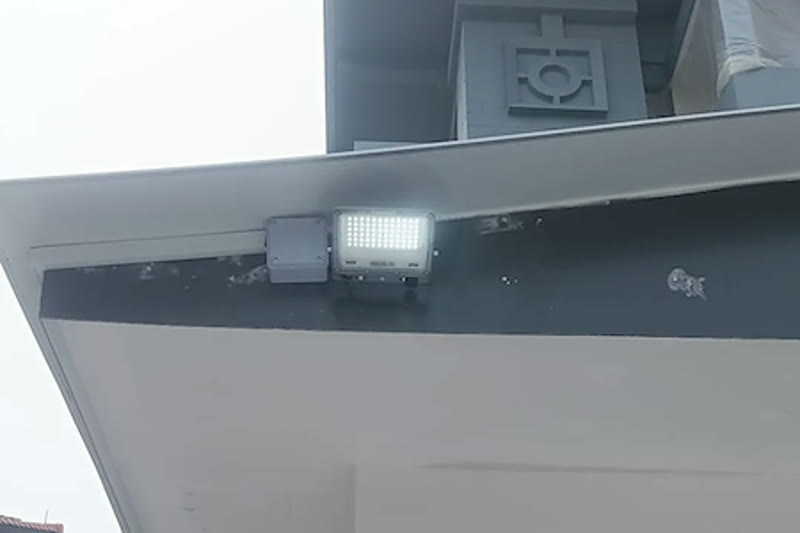
Pictured above: a new LED floodlight and its junction box on the eaves above the car porch of a three-storey semi-detached house we are renovating. Two days earlier the ceiling boards below it were up with the wiring left ready for the lights, waiting to be sanded and painted. The fittings went on after the paint.
Owners of landed houses spend weeks choosing the indoor lights and about ten minutes on the outdoor ones. Then the car porch ceiling is painted, the scaffold comes down, and one evening you stand in the driveway and realise the gate is dark, the side passage is dark, and the only light on the steps is the one you can see from the street. By then the ceiling is closed and the paint is dry. Every light you want to add now is a cable to be run somewhere it was never planned to go.
This is the guide we would want a landed owner to read before the car porch and side passage ceilings go up: what to decide, in what order, and what to ask your contractor. It has no prices in it. Outdoor lighting is a small line inside a landed job, and landed jobs vary too much for a number off a web page to mean anything. Our landed page says the same about the whole job: an on-site survey is essential before any meaningful quote.
Why the soffit paint date is your deadline
On the house in the photo, the order was the one you would expect once you see it written down. The ceiling boards went up across the car porch and the side passage. The joints and screw holes were filled. The wiring was left ready for the lights, loose and waiting. Then the boards were sanded and painted. Only after the paint were the floodlights fixed to the eaves and the lamp fitted on the gate pillar at the front.
The lights go on last because a light fitting is the one thing on a ceiling you do not want painted around, scratched by a sander or splashed by a roller. But the wiring has to be in before the boards close, and the position of every light has to be known by then. That is the same rule that runs through the whole job, and our guide to the order of works explains it: anything that hides something goes in after the thing it hides, so the thing hidden must be right first.
So the date to ask for is not "when are the lights installed". It is "when do the ceiling boards close, and have I given you every light position before that day?"
Decide four things, in this order
1. Where does the light need to fall?
Do not start with fittings. Start with the ground. Decide which patches of the property you want to see at night, and write them down: the car porch floor, the front door step, the gate and the walk from it, the side passage, the bin area, the steps up or down. Each one is either lit by a light above it, a light beside it or a light on a pillar.
The practical test costs nothing. Once the layout is fixed, walk the plot at dusk with a torch and stand where you will actually stand: at the car door, at the gate keying in, at the front door fumbling for a key. Whatever you cannot see from those places is a gap. Mark each position on the plan or on the ceiling itself and ask your contractor to photograph it. A marked ceiling is a position nobody can quietly drop.
2. What switches what?
This decision is invisible in the finished house and very visible in daily life. Decide:
- Where the switches are. One at the front door, one at the gate, one inside by the car porch door? A single switch buried at the far end of the house means walking through the dark to turn on the lights that were meant to stop you walking through the dark.
- Which lights go together. Gate lamps and car porch lights often want to come on together. A side passage you rarely use may want its own switch.
- Whether anything is automatic. A timer or a sensor is a decision about the wiring and the switch position, so it has to be made before the cable is laid, not after the lights are up.
Each of those answers changes how many cables run to each point. That is why it has to be settled before the boards close, not after.
3. What fitting, and can it live outdoors?
An outdoor fitting and its junction box sit in rain, sun and the occasional heavy downpour on a roof edge. Water getting in at a box on the outside of a house is a common way outdoor lights fail, because water finds every gap in time. Ask three things:
- What is the fitting's ingress protection (IP) rating? A fitting meant for the outdoors states one on its datasheet. Ask for it in writing, and ask your electrician whether it suits the exact spot, a sheltered soffit being a different place from an open eave.
- How do the cable and the box keep the water out? The junction box in the photo is a separate enclosure next to the light. Ask what seals the cable entries and who checks them before the scaffold comes down.
- How will somebody reach it in a few years? A fixture on a high eave needs a ladder, and some need a scaffold. If you pick a fitting that cannot be reached without one, you have also picked who has to hire it.
4. Where does the light point, and who else can see it?
A floodlight does what it says. Aimed along a driveway it is useful. Aimed slightly wide, it is in the neighbour's bedroom window, and on a semi-detached or terrace plot that neighbour is a few metres away. Before the fittings are fixed, ask where each one will point and whether the beam will spill over the boundary. If your job involves the shared wall at all, our article on party wall works covers what to do about the neighbour, and a light that irritates them does not help that conversation.
The gate pillar needs its cable before the pillar is finished
A lamp on top of a gate pillar looks like a decorative extra, but the cable to it has to run inside or through the pillar, and a pillar is usually finished, rendered and painted, before the lamp arrives. If the lamp position was not decided, the cable either is not there or has to be forced through a finished pillar.
If you are having an automated gate, plan its power and the pillar lamps together. Our landed page lists gates, fencing and automated gates among the outdoor works we do, with the metal fabricated in our own workshop, and the sensible order is the one on the house in the photo: structure and gate first, fittings last. Settle the pillar cable before the pillar is closed.
Who is allowed to do the wiring
Outdoor wiring is still electrical installation work. Whoever your renovation contractor is, ask for the name and licence number of the licensed electrical worker who will do or supervise it, in writing, before it starts, and ask when the installation will be tested at the end. Our article on electrical work in a renovation explains why a renovation licence and an electrical licence are different things. We wrote that article about HDB flats, so check the specific rules for your house with the electrical worker rather than assuming they match.
Questions to put on any landed lighting quotation
- How many outdoor light points are in the quote, and where are they marked?
- Are the gate and pillar lamps included, and is their cable run before the pillar is finished?
- What is the IP rating of each outdoor fitting, and is it in writing?
- Where is each switch, and what does each one control?
- Is any timer or sensor included, and is its wiring in before the ceiling closes?
- What date do the ceiling boards close, and when do you need my final positions?
- Who is the licensed electrical worker, and when is the installation tested?
- If I add a light after the paint, how will the cable be run, and what does that cost?
The last question is the honest one. A cable added after the paint is either chased into a finished wall or ceiling and made good, or it runs in surface trunking you can see. Neither is what you pictured. A light added before the boards close is, by comparison, almost free.
What goes wrong most often
- Lights chosen after the paint. Everything above becomes a trade-off between a visible cable and a repainted ceiling.
- One switch for everything. It is in the wrong place, and nobody notices until the first night.
- A weather-exposed fitting that is not rated for it. Water gets in, the circuit can trip, and the electrician gets the blame.
- A beam into a neighbour's window. The complaint follows the first night the light is on.
- A pillar lamp with no cable. The pillar is finished and the lamp has nothing to connect to.
What to do this week
- Walk the plot at dusk with a torch and write down every spot you want lit.
- Draw the switches: where each one is and what it controls.
- Ask your contractor in writing for the date the car porch and side passage ceilings close.
- Give every light position before that date and ask for a photo of each one marked on the ceiling or pillar.
- Ask for the IP rating of every outdoor fitting.
We are an HDB Licensed Renovation Contractor, HB-09-5667H, and we handle landed work from interior refreshes to A&A. You can follow the house in the photo on our live jobs page, and our landed renovation contractors page lists what we do on a landed site. Planning the outdoor lights on a landed house? WhatsApp us on 9107 2601 with the address or estate, the house type and the stage the job is at, and we will arrange a site visit. Any price depends on that visit.
Related reading: car porch and landscaping renovation for landed homes · semi-detached house renovation and A&A planning · party wall works on a semi-detached or terrace house · electrical work in a renovation