
4-Room Resale Flat Renovation Package: What Is Actually Included
"Renovation package" is one of the least standardised phrases in Singapore. Two quotations can both say 4-room resale package, sit within a few thousand dollars of each other, and cover genuinely different work — one including the hacking, waterproofing and rewiring that a resale flat actually needs, the other quietly leaving all three as variations to be priced later.
This is what a 4-room resale package should contain, what is normally outside it, and where the resale-specific costs sit. Our full figures are published on the 4-room HDB renovation cost page and are repeated here so you can check a quotation against them line by line.
The headline numbers
A 4-room HDB renovation in Singapore costs $25,000 to $65,000 for most full renovations, inclusive of GST. Within that:
- Basic refresh — from $20,000. Painting, flooring (vinyl or tile overlay), light carpentry, minor electrical, basic kitchen and bathroom upgrades. A bare refresh with no hacking is $15,000–$20,000 if the flat is in good condition.
- Standard renovation — $35,000 to $50,000.
- Full renovation — $45,000 to $65,000. With premium finishes such as sintered stone or smart home integration, $65,000–$80,000.
The number that matters for a resale flat is the adjustment. A resale 4-room adds roughly $5,000 to $15,000 versus the BTO equivalent, because older units need more electrical rewiring and more waterproofing. Read that in the other direction and it explains a lot of suspiciously cheap quotations: a package priced at BTO scope, sold to a resale owner.
What a proper resale package includes
A full renovation package should cover hacking and demolition, full re-tiling, waterproofing, full electrical and plumbing rewiring, custom carpentry, false ceiling, feature walls, painting and sanitary fittings. Taking the ones that carry real money:
Hacking and demolition
In a 4-room flat this usually means removing kitchen and bathroom tiles, taking down the kitchen entrance wall for an open-concept layout, and stripping out fixtures the previous owner built in. Only non-structural walls can be removed. Hacking one non-structural wall costs $800 to $1,500, and the HDB permit is handled by us as part of that price — if a quotation lists the permit as an extra, ask why.
Carpentry — usually the largest single line
All of ours is fabricated in our own Singapore factory. A full kitchen cabinet set of around a 4-metre run costs $3,500 to $8,000. Built-in wardrobes run $200 to $450 per running foot depending on material and finish. With three bedrooms, most 4-room owners order a kitchen set, two to three wardrobes, a TV console and a shoe cabinet — which is why carpentry, not tiling, is where package prices actually diverge.
When you compare two packages, compare the carpentry in running feet and material, not as a single "carpentry" line. A package that is $6,000 cheaper has almost always taken it out of here.
Bathrooms
A bathroom costs $4,000 to $12,000 each, including hacking, waterproofing with a 24-hour ponding test, re-tiling and new sanitary fittings. Multiply by the number you are redoing. The ponding test is the part worth insisting on in writing: it is how you find out the waterproofing works before the tiles go back on, rather than eighteen months later through your neighbour's ceiling.
Kitchen as a standalone
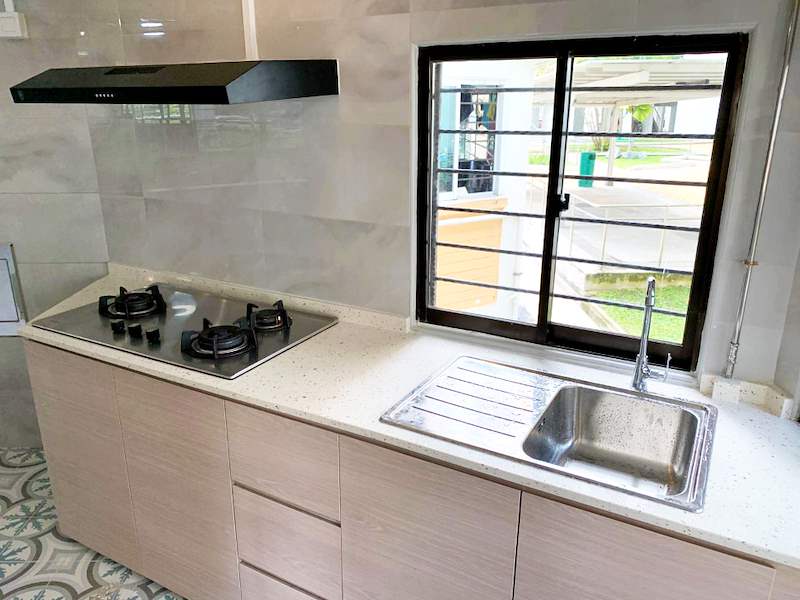
If you are only doing the kitchen, that runs $8,000 to $25,000 — basic ($8,000–$12,000) covers re-tiling, painting and replacing hood and hob; standard ($12,000–$18,000) adds new laminate cabinets and a quartz countertop; premium ($18,000–$25,000) adds sintered stone, soft-close hardware and integrated appliances.
The measured trades
- Tiling — $5 to $15 per square foot supply and installation, depending on homogeneous tile or natural stone.
- Interior painting, two coats including preparation — $1.50 to $3.50 per square foot.
- Gypsum false ceiling with cove lighting — $5 to $10 per square foot.
- Feature wall — $1,500 to $5,000, laminate through to fluted wood, microcement or stone slab.
Masonry — floor screed, kerbs and making good after hacking — sits alongside these and is a mid-sized line item in a 4-room because there is more floor area than a 3-room.
Where resale flats cost more than the brochure
Three things reliably surprise resale buyers, and none of them are optional:
Electrical rewiring. An older flat's circuits were designed for a different household. If you are adding points, moving the kitchen or running a false ceiling, the rewiring is real work rather than a tidy-up, and it belongs in the package rather than in a variation order.
Waterproofing. Existing waterproofing in a resale bathroom is of unknown age and unknown condition. Once you hack the tiles you are committed to redoing it properly.
What the previous owner left. Built-in furniture, an old false ceiling, a converted store, tiles laid over tiles. None of this is visible in a quotation prepared from photos, which is why a site visit before signing matters more on resale than on BTO.
What is normally outside a package
Ask explicitly about these rather than assuming, because practice varies across the industry: appliances and white goods, curtains and blinds, loose furniture, lighting fixtures as opposed to the ceiling work that carries them, air-conditioning supply and installation, and any HDB or town council deposits payable by the flat owner.
A package that includes some of these is not automatically better value — it is a different scope, and the comparison only works once both quotations describe the same work.
Provisional sums, and why they matter more on resale
A provisional sum is a placeholder — an amount put into the quotation for work whose extent nobody can know until something is opened up. On a resale flat there is usually a legitimate reason for one or two: nobody can price rectifying a screed until the old tiles come off.
The problem is not that provisional sums exist. It is that they are the easiest way to make a total look competitive. A package with four provisional sums is not a fixed price, it is an estimate wearing a fixed price's clothes, and the final figure lands after you have already committed.
Two questions settle it. What triggers each provisional sum being converted into a real cost, and who decides the rate at that point? If the answer to the second is "we will let you know", the number in the quotation is decoration.
The order the work happens in
Knowing the sequence helps you read a schedule and spot a package that has not been thought through. Broadly: protection and hacking first, then plumbing and electrical first fix while walls and ceilings are open, then masonry, screed and waterproofing with its ponding test, then tiling, then ceiling and partition work, then carpentry installation, then painting, then second fix — fittings, sanitary ware, lighting — and finally cleaning and handover.
The two fixed points are the ponding test, which cannot be rushed because it takes the time it takes, and carpentry, which is measured on site only after the tiling is down. A schedule that has carpentry being fabricated before tiling is finished is either optimistic or planning to rework something.
Direct contractor versus interior designer
Interior designers add commission, commonly 15% to 40%, on top of contractor pricing. As a direct contractor with our own carpentry factory there is no middleman markup, so you typically save 15% to 30% on the same scope. On a $50,000 renovation that is $7,500 to $15,000.
That saving is only real if the scope is genuinely the same, which brings this back to the same point: compare the work, not the total.
Common questions
What is the minimum for a usable full renovation?
We recommend $25,000 as a floor. Below that, waterproofing or material quality has to be compromised, and that fails within a few years.
Is a resale package really more than a BTO one?
Yes — add roughly $5,000 to $15,000 for the same finished result, mostly rewiring and waterproofing.
Are your prices inclusive of GST?
Yes. The ranges published on this site are GST-inclusive.
Do you handle the HDB permits?
Yes. We are an HDB-licensed renovation contractor, licence HB-09-5667H, and permits for the works we carry out are handled as part of the price.
How do I compare two packages fairly?
Put them side by side on carpentry running feet, number of bathrooms, whether hacking and rewiring are included, and what is listed as a provisional sum. Those five lines explain nearly every price gap.
WhatsApp 9107 2601 about a 4-room resale renovation →
Published cost pages: 4-room HDB renovation cost · 3-room · 5-room · why a direct contractor
Related reading: what to prioritise on a limited budget · reading and comparing quotations · hidden renovation costs
Before you fix a start date for the package, read when you can actually start renovating a resale HDB flat: completion, any extension of stay and the permit all come first.